
Home/Blog/Why Your Driveway Gate is Sagging: Myth-Busting the Quick Fixes
August 27, 2026
Why Your Driveway Gate is Sagging: Myth-Busting the Quick Fixes
Is your sagging gate scraping the drive? Stop wasting time on quick fixes. Learn the real causes of poor driveway gate alignment and find a permanent solution.
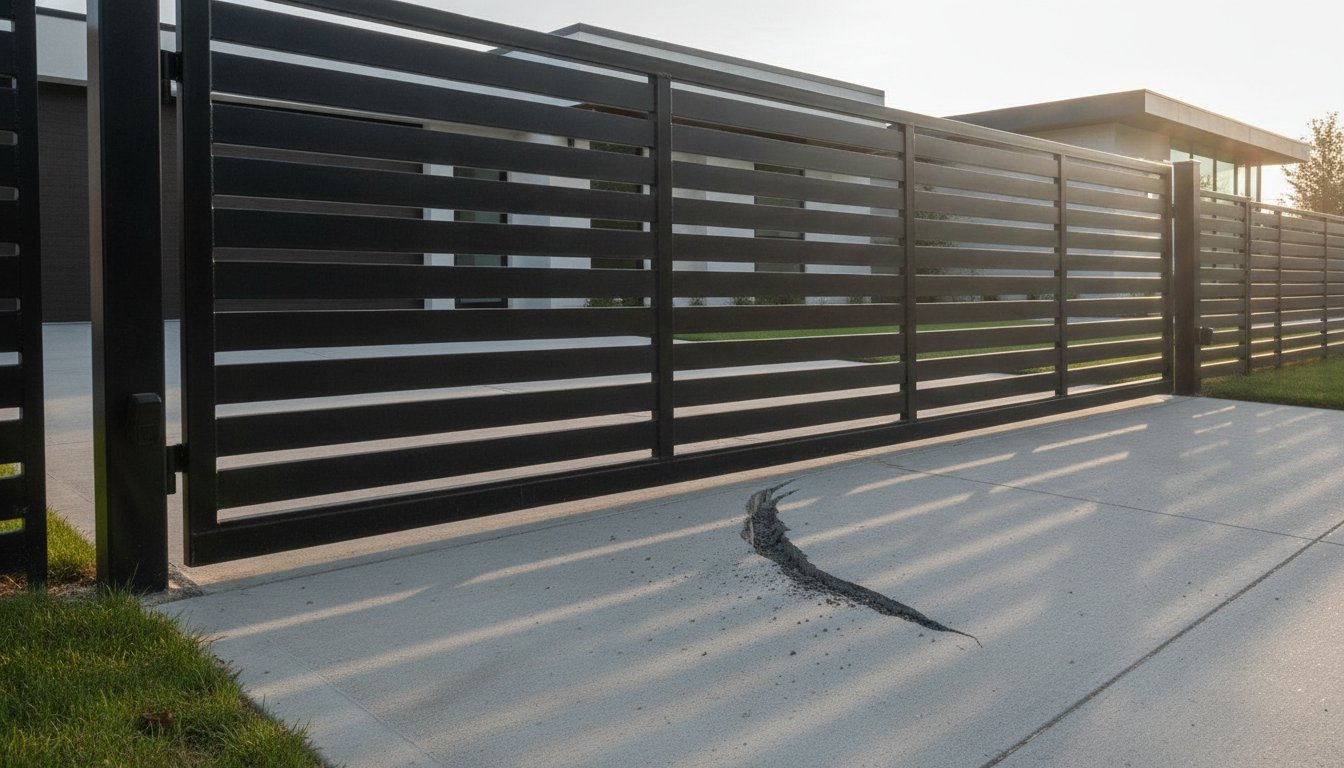
Most homeowners think a sagging gate is just one loose bolt away from being fixed. They're wrong. If your gate is scraping the concrete or your operator is stalling, you're looking at a structural failure, not a simple maintenance task. Proper driveway gate alignment depends on sound engineering, not just a wrench. You've probably already tried tightening the hinges or shimming the post, only to find the gate dragging again a week later.
It's exhausting to fight your own property every time you pull into the drive. You want a gate that glides, not one that strains the motor and ruins your curb appeal. This guide breaks down why common DIY hacks actually accelerate structural damage and waste your money. We'll identify the real root causes of sag, from North Texas soil shifts to internal frame fatigue. You'll learn how to distinguish a temporary band-aid from a permanent solution, and exactly when a gate is structurally unsalvageable.
Key Takeaways
- Gravity turns your gate into a massive lever. Learn how a 200lb gate exerts thousands of pounds of force on your hardware.
- Stop using gate wheels as a permanent fix. These accessories often bind on uneven driveways and accelerate frame damage.
- Turnbuckles and cables are temporary tension fixes. They won't provide the permanent driveway gate alignment that rigid, welded steel members offer.
- Soil movement is the silent killer of gates in North Texas. Discover why shallow foundations fail in our specific clay environment.
- Learn to distinguish between a simple hinge adjustment and a total structural failure that requires a master fabricator's touch.
The Physics of Gate Sag: Why Gravity Always Wins
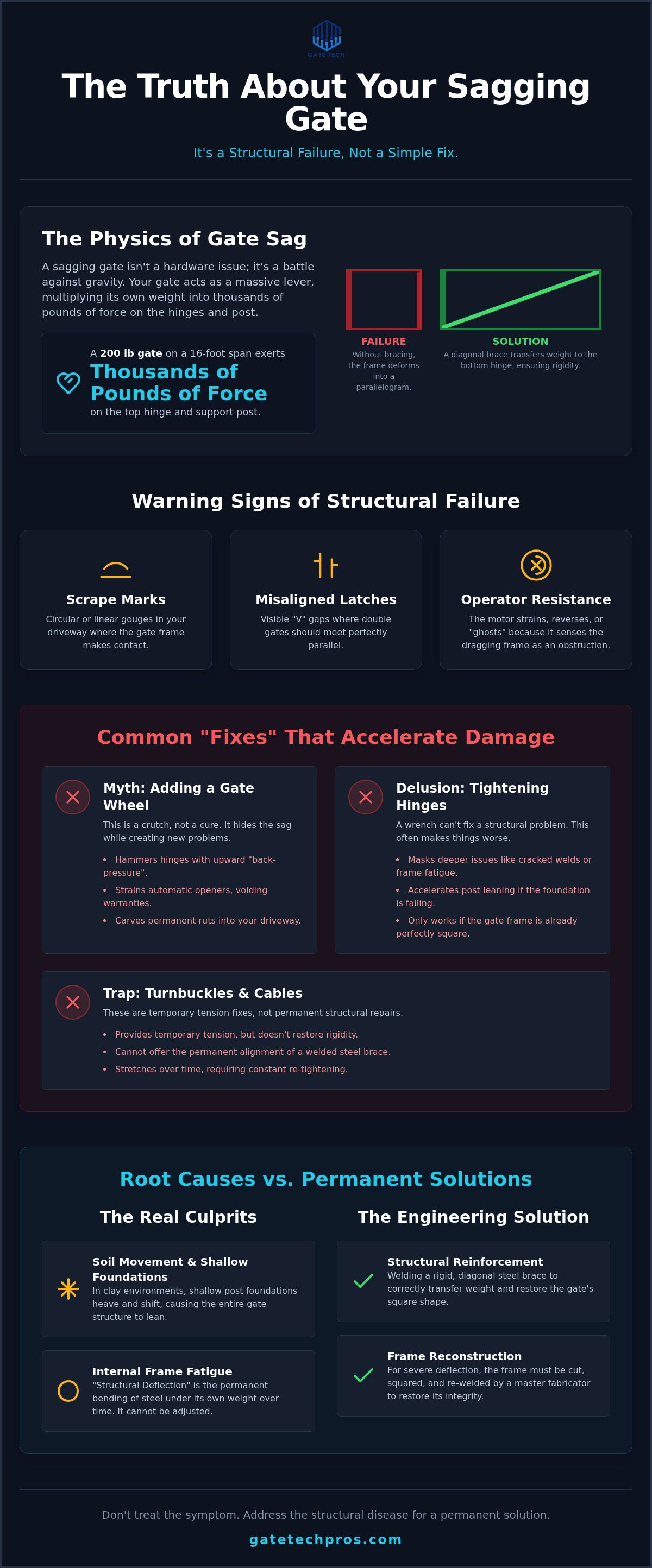
Gate sag isn't a mystery; it's a progressive mechanical failure. It occurs when the structural integrity of the frame deflects or the support post begins to lean under constant load. Many homeowners mistake this for a simple hardware issue, but the reality is rooted in physics. Maintaining proper driveway gate alignment requires understanding that your gate is essentially a giant pry bar. This is the lever arm effect in action. A 200lb gate on a 16-foot span doesn't just exert 200lbs of pressure. It multiplies that force at the pivot point, often placing thousands of pounds of tension on the top hinge and equal compression on the bottom.
Diagonal bracing is the only way to combat this force. A correctly engineered brace transfers the weight from the top of the latch side back down to the bottom hinge. Without this rigid path, the rectangular frame eventually settles into a parallelogram. Once this happens, you've reached a state of structural deflection. Structural deflection is the permanent bending of steel under its own weight. At this stage, no amount of lubricant or adjustment will return the gate to its original shape.
Signs Your Gate is Losing the Battle
You'll see the evidence of failure long before the gate stops moving entirely. Physical symptoms include:
- Scrape marks: Circular or linear gouges in the concrete or asphalt driveway where the gate frame makes contact.
- Misaligned latches: Visible gaps at the latch point or "V" shapes where double gates should meet perfectly parallel.
- Operator resistance: The gate motor reverses or "ghosts" because it senses the friction of a dragging frame as an obstruction.
The "Hinge Adjustment" Delusion
A common mistake is assuming a wrench can solve a structural problem. Tightening a hinge nut only works if the frame itself is still square and the post is plumb. If you're dealing with a failing post, over-tightening the hinges actually accelerates the lean by pulling the post further out of the ground. In many cases, homeowners unknowingly use hinge adjustments to mask a cracked weld or a failing internal brace. This doesn't fix the driveway gate alignment; it just delays the inevitable collapse. You're treating the symptom while the structural disease continues to spread. If the frame has deflected, the only real solution involves cutting, squaring, and re-welding the steel to restore its original rigidity.
Myth #1: Adding a Wheel to the Gate End Solves the Problem
Walk into any big-box hardware store and you'll find "gate helper" wheels. They're marketed as a cheap solution for a dragging frame. They're a mistake. A wheel is a crutch for a broken leg. It doesn't heal the injury; it just lets you limp until the rest of the structure fails. When you bolt a wheel onto a gate to bypass poor driveway gate alignment, you aren't solving the sag. You're hiding it. You're also creating a host of new mechanical problems that will eventually cost more than the original repair.
The physics of a wheel are fundamentally flawed for swing gates. Hinges are designed to manage downward tension and horizontal pull. A wheel introduces "back-pressure." Every time the wheel hits a driveway transition, a slope, or a stray pebble, it hammers the gate leaf upward. This forces the hinge pins to work in the wrong direction. Instead of the gate hanging naturally, it's being bounced. This creates micro-fractures in the welds and eventually snaps the hinge assembly entirely.
Why Automatic Operators Hate Gate Wheels
Automatic openers are precision instruments. They're calibrated to move a specific weight with minimal resistance. Adding a wheel introduces massive friction. If the wheel binds or hits a bump, the motor has to pull twice as hard to maintain momentum. This constant straining significantly shortens the lifespan of the internal gears. Most manufacturers will void your warranty if they see a support wheel on the gate. It's a sign that the motor was forced to overcome a mechanical failure. For lasting results, professional gate repairs must focus on the frame's integrity, not adding more moving parts that can fail.
The Surface Problem: Driveway Wear
Think about your driveway. Whether it's brushed concrete, pavers, or decorative stone, it wasn't meant to be a track. Metal or hard plastic wheels are abrasive. Over hundreds of cycles, they will carve a permanent rut into your entrance. This isn't just an eyesore; it's a drainage trap that collects water and debris, further worsening the wheel's performance. A properly engineered gate should "float" perfectly above the ground. If your gate needs a wheel to stay upright, the foundation or the frame has already failed. You need a structural diagnostic to find the real break point before you destroy your driveway along with your gate.
Myth #2: Turnbuckles and Cables are Permanent Structural Fixes
Turnbuckles are the "quick fix" of choice for a sagging frame. They work by applying tension across the diagonal of the gate leaf. While this might temporarily improve driveway gate alignment, it's a fundamentally flawed approach for steel structures. Steel gates require rigid diagonal members to maintain their shape. Cables only provide tension. They cannot provide the compression strength needed to resist the gravity-driven forces that cause sag. Over time, the cable stretches or the turnbuckle vibrates loose. You're left right back where you started with a dragging gate.
The attachment points for these cables often become sites for metal fatigue. When you drill into a gate frame to mount a DIY kit, you weaken the steel. The constant pulling of the cable creates stress concentrations that lead to hairline cracks in the metal. This is the opposite of the custom gate design process used by professionals. We use internal gussets and heavy-duty welded bracing to ensure the frame remains square. A properly built gate stays aligned because of its internal geometry, not because of external wires.
The Failure of Thin-Walled Steel
Most "big box store" gates are manufactured from thin-walled, 16-gauge steel or lighter. These frames are too flimsy to support the high-tension loads required by a cable kit. When you tighten the turnbuckle, the cable doesn't just pull the gate square. It often bows the vertical members inward. This warping ruins the structural integrity of the entire leaf. High-quality fabrication relies on gauge thickness and weld penetration, not hardware store accessories. If your gate frame is thin enough to bend under a cable's tension, it was never built to last. It lacks the rigidity required for long-term driveway gate alignment.
When Cables Become a Safety Hazard
A sagging gate is a nuisance; a snapped cable is a danger. High wind loads in North Texas put immense strain on gate surfaces. If a tension cable fails under load, it can whip across the driveway with enough force to cause injury or property damage. These DIY additions also frequently interfere with UL 325 safety standards. Cables can block photo-eye sensors or create new entrapment points where a person's limb could get caught during the gate's cycle. Altering the geometry of a gate with external wires creates a liability. Stick to engineered solutions that prioritize safety and structural permanence.
The Root Cause: Foundation Depth and Soil Shifts in North Texas
North Texas soil is alive. The black gumbo clay common across the DFW Metroplex is notorious for its "heave and shrink" cycle. When it rains, the clay expands with massive hydraulic force. When it dries, it contracts, leaving deep fissures in the earth. This constant movement is the primary enemy of long-term driveway gate alignment. If your foundation isn't deep enough to bypass this active layer, your gate will never stay level. Most "standard" installers dig two feet deep. That's a guaranteed failure. A 24-inch hole works for a static fence panel, but it cannot support the dynamic, swinging load of a heavy gate.
The physics of a gate post require a specific ratio of post height to footer mass. A heavy gate acts as a lever. It tries to pull the post out of the ground with every cycle. Without enough concrete weight underground, the soil simply gives way. This is why galvanized steel gate maintenance actually starts beneath the surface. If the foundation shifts, the most expensive galvanized frame in the world will still drag across your driveway. You can't maintain what isn't stable.
The "Iceberg" Rule for Gate Posts
The most important part of your gate is the concrete you can't see. Think of your support post like an iceberg. For every foot of steel above ground, you need significant mass below it to resist the leverage of a 16-foot gate leaf. Professional standards in North Texas require depths of 36 to 48 inches. We also utilize bell-bottom piers. By flaring the bottom of the concrete footer, we create a physical wedge that the soil cannot easily push upward during a heave cycle. It's about anchoring into stable earth, not just sitting in the topsoil.
Diagnosing a Leaning Post vs. a Sagging Frame
Before you start welding, you must identify the failure point. Place a level on the support post. If the post isn't perfectly plumb, your driveway gate alignment issue is a foundation problem. You might also notice "post rotation." This happens when a high-torque operator twists the post within its concrete base because the footer was too small. A leaning post requires a full reset. Shimming the hinges is a waste of time. If the dirt has moved, the post has to move back. For a permanent fix, you need a foundation diagnostic and structural reset from a team that understands North Texas geology.
Restoring Alignment: Structural Engineering vs. Surface-Level Repairs
Most gate companies are really just parts changers. They see a sagging gate and reach for a bigger hinge or a longer bolt. That's a surface-level repair. It doesn't solve the geometry problem. True driveway gate alignment requires structural restoration. This means identifying where the steel has yielded and reinforcing the frame through precision welding. At Gate Tech Pros, we don't just swap components; we diagnose the "why" behind the failure and fix the root cause.
We use galvanized steel for a specific reason. Raw steel gates rust from the inside out. By the time you see a streak of orange on the outside, the structural integrity of the tube is already compromised. Galvanization protects the metal in the humid North Texas climate. Our in-house fabrication shop in Argyle allows us to correct failed gate geometry that other companies would simply walk away from. We don't rely on third-party kits or flimsy pre-made panels. We build to withstand specific wind loads and heavy spans. This ensures the gate stays square for decades, not just until the next season change.
The Gate Tech Pros Diagnostic Approach
We start with a technical audit. We verify frame squareness using precision levels and laser measurements. We don't guess. We also inspect every weld at high-stress pivot points for micro-fractures. If a gate has integrated pedestrian gate access control systems, we check for secondary alignment issues. A sagging driveway gate often pulls the adjacent fencing or pedestrian entries out of plumb. This compromises your entire perimeter security and puts unnecessary stress on electronic locks and strike plates.
When to Rebuild Instead of Repair
Sometimes, repair is a bad investment. If we find "metal rot" where the steel has thinned too much to accept a sound weld, we'll tell you. Welding onto paper-thin rust is a liability. We also see many undersized gates on spans that are simply too long for the original material gauge. In these cases, a new, engineered entry package is the only logical choice for permanent driveway gate alignment. It's about cost-benefit. You can pay for endless repairs on a failing system, or you can invest once in a galvanized, structurally sound gate that works every time. Stop using band-aids. Get a professional structural diagnostic and fix your gate correctly the first time.
Stop the Drag and Restore Structural Integrity
A dragging gate is more than an eyesore; it's a mechanical failure waiting to happen. You've seen why hardware store wheels and tension cables are temporary band-aids that often accelerate damage. These "hacks" ignore the physics of the lever arm and the volatile nature of North Texas soil. Achieving permanent driveway gate alignment requires a deep understanding of structural engineering and foundation mass. If the frame has deflected or the post has shifted, a simple wrench won't solve the problem.
Gate Tech Pros specializes in solving these complex failures. Our in-house Argyle fabrication shop builds custom galvanized steel solutions designed to withstand local humidity and shifting clay. We don't just patch symptoms. We perform UL 325 safety compliant repairs that address the root cause of the sag. It's time to stop fighting your entrance and invest in a system that glides effortlessly every time you pull into your drive.
Get a Professional Structural Diagnostic for Your Sagging Gate today. Your property deserves a perimeter that works as hard as you do.
Frequently Asked Questions
Why is my driveway gate dragging on the ground?
Your gate is dragging because of structural deflection or foundation failure. Over time, gravity pulls the unsupported latch side toward the ground, warping the frame into a parallelogram. In the DFW area, this often happens because of shifting clay soil. When the earth moves, shallow posts lean, ruining your driveway gate alignment. Identifying whether the issue is in the metal or the dirt is the first step toward a permanent fix.
Can I fix a sagging gate by just tightening the hinges?
Tightening hinges only works if the hardware is physically loose. If the gate frame is bent or the support post is leaning, adjusting the bolts is a temporary band-aid. It doesn't address the structural yield of the steel or the failure of the concrete footing. Forcing a misaligned gate into place with hinge adjustments often puts uneven stress on the pivot points, leading to cracked welds or snapped pins.
Is it safe to put a wheel on the end of a sagging gate?
It isn't safe or effective. Support wheels are a shortcut that creates new mechanical problems. They force the gate upward every time they hit a bump, which hammers the hinges in the wrong direction. This "back-pressure" can snap hinge pins or crack the frame. Additionally, wheels often bind on driveway transitions, causing automatic operators to stall or trigger safety reversals. A properly engineered gate should float without ground contact.
How much does it cost to fix a sagging driveway gate?
Repair costs depend entirely on the diagnostic findings. A localized weld repair is a different project than a full post reset or a frame rebuild. Every structural failure is unique to the soil conditions and the original fabrication quality of the gate. We recommend a professional diagnostic to identify the specific failure points. This prevents you from wasting money on surface-level fixes that won't hold up over time.
How deep should driveway gate posts be set in Texas?
Driveway gate posts in Texas should be set between 36 and 48 inches deep. The 24-inch depth used for standard fences is insufficient for the dynamic load of a swinging gate. Deep footers are required to bypass the active layer of North Texas clay, which expands and contracts with moisture. Utilizing bell-bottom piers at these depths provides the necessary mass to resist the leverage of a heavy gate leaf.
Can a sagging gate damage my automatic gate opener?
Yes, a dragging gate is a primary cause of operator failure. The motor is designed to move a balanced load with minimal resistance. When a gate sags, the friction against the driveway or the latch post forces the gears to work significantly harder. This constant straining shortens the lifespan of the opener and can void your warranty. Proper driveway gate alignment is essential for protecting your investment in automation.
What is the best material for a gate that wont sag?
Galvanized steel is the superior choice for structural longevity. Unlike raw steel or wood, galvanized frames are protected against internal corrosion that hides inside the tubing. Steel provides the necessary rigidity to prevent deflection on long spans. When combined with internal diagonal bracing and thick-walled tube, galvanized steel creates a frame that remains square and plumb even under the high wind loads common in the Argyle area.
How do I know if my gate post is leaning or the gate itself is sagging?
You can determine the source of the sag using a standard four-foot level. First, check the support post. If the post isn't perfectly vertical, your foundation has shifted. If the post is plumb but the gate is still dragging, the frame itself has deflected. Sometimes both issues occur simultaneously. A professional diagnostic uses precision tools to verify the squareness of every corner, ensuring the repair addresses the correct mechanical failure.
- driveway gate alignment
Need this done on your property?
Tell us the gate type, what it's doing, and the address.