
Home/Blog/Multi-Tenant Telephone Entry System Installation: A 2026 Integration Case Study
August 30, 2026
Multi-Tenant Telephone Entry System Installation: A 2026 Integration Case Study
Upgrade your failing multi-tenant telephone entry system. Our 2026 case study shows how to integrate a modern, cloud-based solution and end tenant frustration.
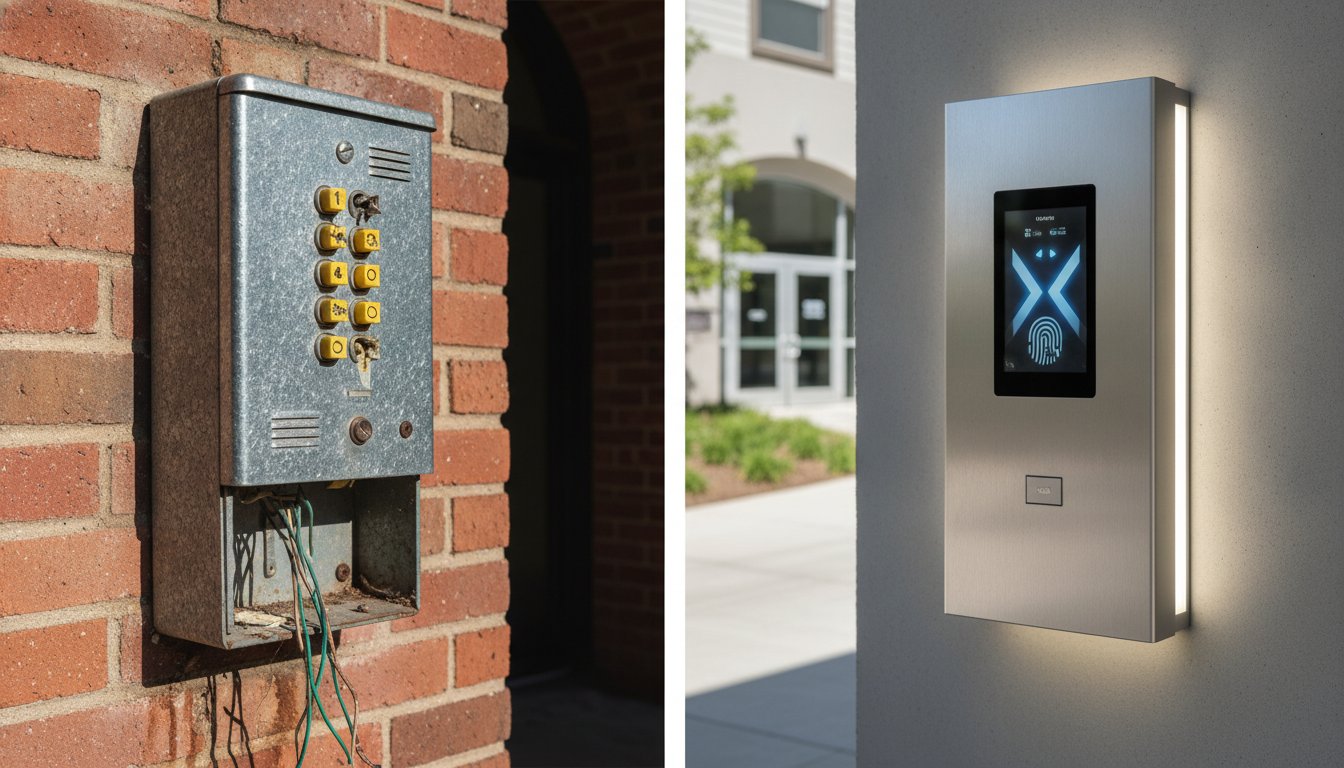
Why do property managers keep pouring money into a multi-tenant telephone entry system that relies on technology the FCC effectively retired back in 2022? It's a losing battle. Your tenants are frustrated by broken buzzers and security codes that haven't been updated in years. You're likely stuck paying for landline maintenance on a copper network that AT&T is scheduled to retire completely by 2029. Most systems don't fail because the hardware is cheap; they fail because the infrastructure behind them is obsolete.
We know the specific stress of an entry system that quits the moment a North Texas heatwave hits. It's the difference between a functional property and a security liability. You need a setup that works with your existing gate hardware instead of fighting against it. This guide teaches you how to transition from failing legacy intercoms to high-reliability cloud-based entry systems. We'll walk through the technical requirements of a 2026 installation, from bypassing old copper lines to ensuring your new software communicates perfectly with your gate operators. It's time to stop patching holes and start building a system that actually works.
Key Takeaways
- Stop fighting obsolete copper lines and learn why the 2026 technical landscape requires a shift toward cloud-managed entry.
- Evaluate the specific infrastructure needs of VoIP versus cellular setups to choose a multi-tenant telephone entry system that fits your property’s footprint.
- Review a real-world diagnostic process that uncovers hidden issues like rotted underground wiring before they lead to tenant lockouts.
- Identify the hardware specifications, such as stainless steel housing and directory capacity, required to survive the North Texas environment.
- Master the integration between your access control software and gate operators to ensure a reliable trigger signal through a unified one-crew installation.
Beyond the Buzz: Why Legacy Multi-Tenant Telephone Entry Systems Fail
A multi-tenant telephone entry system acts as the primary security gatekeeper for your residential complex. It is the first point of contact for every visitor and the first line of defense for every resident. For decades, these units were the gold standard for perimeter control. They were simple, rugged, and reliable. But the tech landscape has shifted. By 2026, the traditional hardware that property managers relied on for years has become a liability. The problem isn't just the box on the wall; it's the infrastructure connecting it to the world.
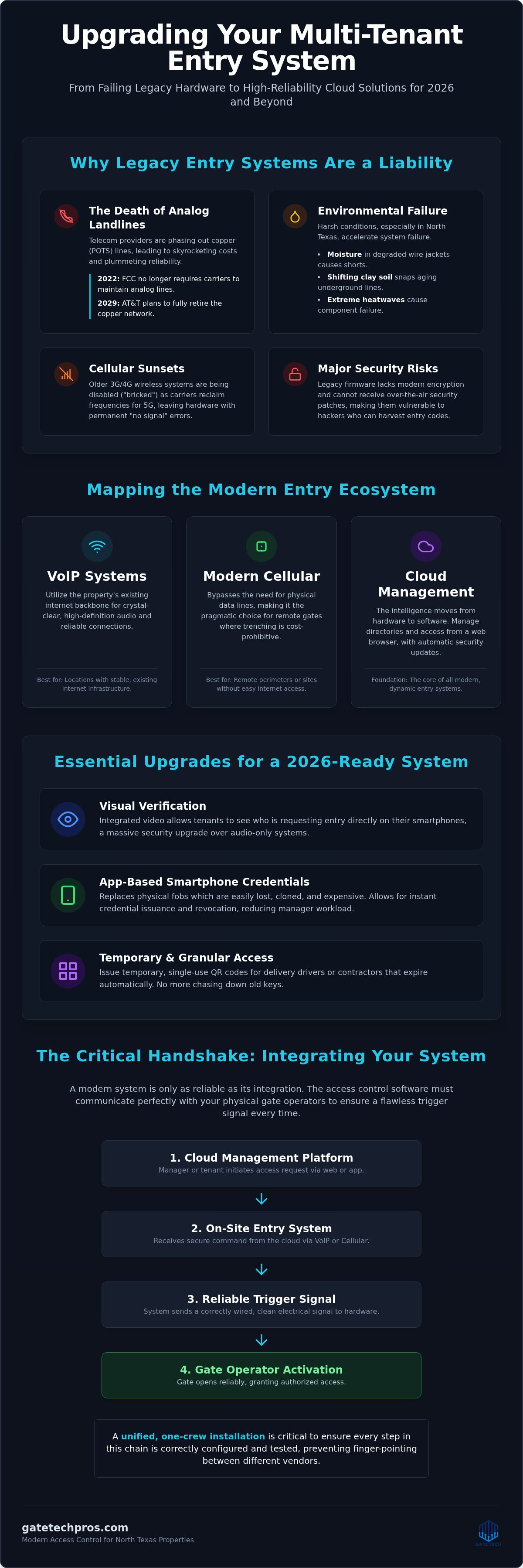
The 2026 reality is harsh. Landline costs are skyrocketing while reliability is plummeting. We see this daily across North Texas. Systems fail because of copper wire degradation and moisture seeping into old underground conduits. Shifting clay soil snaps aging lines, and finding a technician who can actually "fix" a physical phone line is becoming impossible. For many properties, "just fixing it" is a sunken cost. You're paying premium rates to patch a system that the telecom industry is actively trying to kill.
The Death of the Analog Landline
Telecom providers are moving fast to phase out traditional copper lines. Under FCC Order 19-72, carriers are no longer required to maintain analog Plain Old Telephone Service (POTS). This shift is the primary reason your monthly bills for entry lines have tripled. AT&T has already stopped taking new copper orders and plans to retire the network entirely by 2029. These aging intercom systems weren't built for this transition. During North Texas storm seasons, moisture enters degraded wire jackets and causes shorts. You don't just lose audio; you lose the ability to trigger the gate, leaving residents stranded outside in the rain.
Cellular Sunsets and Hardware Obsolescence
Wireless systems aren't immune to these changes. The ongoing 3G and 4G sunsets are effectively bricking older units from major brands like DoorKing and LiftMaster. If your multi-tenant telephone entry system relies on an older cellular modem, it's likely on borrowed time. Carriers are reclaiming those frequencies for 5G, leaving legacy hardware with "no signal" errors that no amount of rebooting can fix. Beyond the connectivity issues, legacy firmware presents a massive security risk. These older systems lack modern encryption, making them vulnerable to hackers who can harvest entry codes or bypass the lock entirely. If your hardware can't receive over-the-air security patches, it's already obsolete.
Mapping the Modern Entry Ecosystem: VoIP vs. Cellular vs. Cloud
Legacy systems failed because they were isolated. Modern systems succeed because they are connected. A cloud-based multi-tenant telephone entry system eliminates the need for on-site programming. You manage the tenant directory from a web browser, not a physical keypad in the rain. This shift moves the intelligence from the hardware to the software. It’s a transition from a static box to a dynamic service that stays current through automatic updates.
VoIP solutions provide high-definition audio by using your property’s existing internet backbone. It’s clear. It’s fast. It doesn't suffer from the static of old copper lines. For remote perimeter gates where trenching through limestone or asphalt is cost-prohibitive, cellular entry is the pragmatic choice. It bypasses the need for physical data lines entirely. These systems are also moving beyond simple voice calls. Industry experts agree the next frontier for the sector is visual verification. Video integration allows tenants to see exactly who is requesting entry. This is a massive security upgrade over the "who is it?" guessing game of the 1990s.
The Rise of App-Based Tenant Access
Physical fobs are a management liability. They are easy to lose, expensive to replace, and simple to clone. Smartphone credentials turn a resident's mobile device into a secure digital key. This reduces the property manager's workload by allowing for instant credential revocation. You can issue temporary QR codes for delivery drivers or contractors that expire after a single use. It’s about granular control. No more chasing down old keys from former residents or worrying about unauthorized duplicates circulating in the community.
Infrastructure Requirements for 2026 Upgrades
You can't just swap the head unit and hope for the best. Power requirements are specific. Some units need 12VDC, while others require 24VAC directly from the gate operator. Data reliability is equally critical. While Wi-Fi is an option for smaller sites, we recommend hardwired Ethernet for mission-critical entry points to avoid signal interference. LTE or 5G modems serve as excellent fail-safes for high-traffic areas. Before you commit to a hardware package, evaluate your existing conduit. If the old copper lines are rotted, you might need a new wire pull to support modern data speeds. A thorough diagnostic of your gate electronics ensures your new system won't fail because of a neglected underground connection.
Case Study: Modernizing a 150-Unit Apartment Complex in North Texas
A 150-unit apartment complex in Fort Worth faced a recurring nightmare. Their aging multi-tenant telephone entry system was dropping calls daily. Tenants were trapped outside. The property manager was fielding dozens of angry calls every weekend. A competitor had already replaced the main circuit board twice, but the system still glitched during every heavy rain. When our team arrived, we didn't just look at the keypad. We looked at the entire ecosystem. The diagnosis was clear: a failing control board was only half the problem. Rotted underground wiring and high mechanical drag on the gates were the true culprits.
The solution required a complete technical overhaul. We replaced the failing analog unit with a modern cloud-based video system featuring integrated RFID. This wasn't a superficial hardware swap. It was a strategic integration designed to survive the specific environmental pressures of North Texas. The result was immediate. Management reported a 40% reduction in administrative overhead because they no longer had to manually program fobs or troubleshoot landline static. Since the 2026 installation, the property has experienced zero hardware failures.
Phase 1: Structural and Electrical Audit
We started with the physical foundation. It’s a mistake to put a high-tech entry system on a low-tech, failing gate. Our team tested the existing gate operator for mechanical drag. We discovered the hinges were binding, forcing the motor to draw excessive amperage. This electrical noise was actually interfering with the entry system's data signals. We performed necessary gate repairs to restore mechanical balance before touching a single wire. Finally, we mapped the power path from the leasing office. We found the original 18-gauge wire was insufficient for modern cloud hardware, so we pulled new shielded cabling through the existing conduit to ensure a clean power supply.
Phase 2: Installation and UL 325 Commissioning
The installation phase focused on durability. We mounted the new entry panel on a custom galvanized steel pedestal fabricated in our Argyle shop. This protects the electronics from the humidity and soil shifts common in Fort Worth. Programming 150+ tenants was handled through a cloud dashboard in under an hour. We didn't leave the site after the last screw was tightened. We conducted rigorous final safety testing for UL 325 compliance. This included verifying that the entrapment protection sensors communicated perfectly with the new multi-tenant telephone entry system. This "one crew" approach ensured the software, the gate motor, and the physical steel worked as a single, reliable unit.
Strategic Selection: Choosing the Right Hardware for Your Site
Selecting a multi-tenant telephone entry system is a long-term commitment to your property's security and operational flow. It's not just about picking a box that looks good on a pedestal. You need to match the hardware to the specific environmental and logistical demands of your site. In North Texas, the primary enemy is the sun and humidity. Plastic housings and cheap membrane keypads will fail within three seasons. Stainless steel or powder-coated aluminum housings are mandatory. They resist corrosion and protect the delicate internal control boards from the 100-degree spikes and sudden freezes common in our region.
Capacity is your next hurdle. A common mistake is buying for your current occupancy rather than your total unit count plus guest overhead. If you manage a 150-unit complex, a 150-name directory is insufficient. You need room for staff, emergency services, and turnover. Integration is the third pillar. Your entry system must speak the same electrical language as your gate operator. We often see brand-new panels that can't properly trigger an older motor because of voltage mismatches. Finally, every new installation must be an opportunity to verify UL 325 safety compliance. If your entry system doesn't properly integrate with entrapment protection sensors, you're looking at a massive liability. Most installers ignore this, but failing to sync the entry system with safety loops is a major oversight.
Top Brands for Commercial Reliability
We focus on three heavyweights that have proven their worth in the field. DoorKing (DKS) remains the industry standard for rugged durability. Their units are built like tanks and are often the best choice for high-traffic industrial or residential sites where physical abuse is a factor. LiftMaster has taken the lead in cloud integration. Their systems offer the most seamless app support for tenants, allowing for remote unlocking and visual verification through the myQ ecosystem. For properties where video clarity is the top priority, Aiphone is the specialist. Their multi-tenant video intercoms offer superior optics and audio processing, ensuring residents can clearly identify visitors before granting access.
Budgeting for Total Cost of Ownership
The sticker price of the hardware is only the beginning. You must factor in the long-term costs of cellular data plans or cloud subscription fees. While a legacy landline system might seem cheaper upfront, the rising cost of analog line maintenance quickly eclipses modern cloud fees. Investing in professional commercial gate keypad installation saves money by reducing the frequency of emergency service calls caused by poor wiring or incorrect programming. Professional installers ensure the firmware is updated and the system is hardened against local weather. Before you sign off on a new unit, ask about the cost of future software updates and technical support. If you want a system that stays online without constant babysitting, contact our team for a site-specific hardware recommendation.
The Critical Handshake: Integrating Access Control with Gate Operators
A multi-tenant telephone entry system is only as reliable as its connection to the gate motor. This connection, often called the "handshake," is where most amateur installations fail. It isn't enough to just mount the hardware; you must ensure the electronic trigger signal translates perfectly into mechanical movement. When a resident presses the "unlock" button on their smartphone, the entry system closes a dry contact relay. This closure completes a circuit on the gate operator's control board, telling the motor to start the cycle. If the wiring is thin or the relay is improperly configured, the signal dies before it reaches the operator.
Managing multiple entry points adds another layer of complexity. High-density properties usually have a mix of driveway gates and pedestrian gates. A centralized multi-tenant telephone entry system must be programmed to distinguish between these zones. You don't want a guest at the pedestrian gate accidentally swinging open the heavy vehicle gate. We also integrate loop detectors into this handshake logic. These sensors prevent the gate from closing on a vehicle while it’s still in the path. This isn't just a convenience; it's a liability shield. A "one crew" approach is essential here. When the team that understands the software also understands the mechanical drag of the gate, you eliminate the finger-pointing that happens when the tech and the hardware don't sync.
Wiring the Relay: 2-Wire vs. 4-Wire Configurations
The physical wiring determines the system's resilience. Most installations use a "Normally Open" circuit logic, where the circuit only closes during a valid entry command. We prefer 4-wire configurations over 2-wire setups for commercial sites. Separating the power supply from the data and trigger lines reduces signal noise and protects the sensitive entry panel from voltage spikes generated by the gate motor. It’s also vital to ensure the emergency override, or Fire Box, remains on a dedicated priority circuit. If the entry system loses power, the fire department must still be able to trigger the gate mechanically without software interference.
Synchronizing RFID and Telephone Entry
Residents expect a unified experience. They want one RFID credential or mobile key to work at the main gate, the gym, and the pool. Synchronizing these points requires a clean database. We help property managers purge old codes and fobs to prevent "ghost access" from former tenants. In high-density North Texas complexes, signal interference can be a challenge for wireless RFID readers. We use shielded cabling and strategic reader placement to ensure the 125kHz or 13.56MHz signals aren't drowned out by nearby electrical transformers. This level of technical precision ensures that the "handshake" happens instantly, every single time.
Securing Your Property’s Future with Integrated Access
The 2026 technical landscape doesn't leave room for guesswork or outdated copper lines. Upgrading your multi-tenant telephone entry system is a necessity driven by the analog sunset and the rising demand for visual verification. Success requires more than just a new keypad on a post; it demands a technical synergy where the software, the electrical relay, and the physical gate operator work as a single unit. You've seen how identifying rotted wiring and mechanical drag can prevent the constant cycle of temporary fixes that drain your maintenance budget.
Don't settle for a fragmented installation that fails during the next heatwave. Our team brings North Texas local expertise to every site, using custom galvanized steel pedestals fabricated in our own shop to ensure your hardware survives the environment. Our UL 325 certified technicians handle everything from the initial diagnostic to the final safety commissioning. It's time to stabilize your perimeter with a system built for long-term functional excellence. Get a Professional Access Control Audit from Gate Tech Pros and stop managing failures. Your property deserves an entry solution that actually works.
Frequently Asked Questions
What is the best multi-tenant telephone entry system for 2026?
The best system for 2026 is one that combines rugged hardware with cloud-based management. Brands like LiftMaster and DoorKing lead the industry because they've transitioned from legacy analog tech to IP-based platforms. You should prioritize hardware that offers visual verification and smartphone app compatibility. This ensures your property stays relevant as residents move away from physical fobs. We recommend systems with stainless steel housing to survive the North Texas heat and humidity.
Can I upgrade my telephone entry system without running new wires?
You can upgrade using cellular or Wi-Fi technology to bypass the need for new data trenches. Cellular systems are the most common choice for retrofitting remote gates where running new Ethernet is cost-prohibitive. However, you must verify your existing power wires can handle the 12VDC or 24VAC requirements of modern hardware. While wireless options save on initial labor, a hardwired Ethernet connection remains the most stable choice for high-traffic commercial entry points.
How much does it cost to install a multi-tenant intercom system?
Total installation costs depend on your unit count, the complexity of your gate hardware, and the state of your existing conduit. A small complex with a single entry point requires a different investment than a 500-unit luxury portfolio. You must account for the hardware, professional configuration, and any structural repairs needed for UL 325 safety compliance. We focus on project-based fees that cover the end-to-end design, fabrication, and onsite commissioning of your entry package.
Do I need a landline for my apartment gate entry system?
No, you don't need a landline, and we actively advise against them. Telecom providers are retiring copper networks, which makes landline maintenance unreliable and expensive. Modern systems use cellular LTE, VoIP, or dedicated internet connections to communicate with tenants. These digital alternatives provide clearer audio and allow for video verification, which a standard analog phone line cannot support. Moving away from landlines is the first step in future-proofing your property against the 2029 copper retirement.
What is the difference between a telephone entry system and an intercom?
A traditional telephone entry system uses the public telephone network or VoIP to call a resident’s phone. An intercom was historically a point-to-point system with dedicated hardware inside each apartment unit. In 2026, these lines have blurred. Modern intercoms are often cloud-based apps on a tenant’s smartphone. The primary difference now is how the handshake occurs: one relies on a phone number, while the other uses a data-driven app interface for visual verification.
Are cloud-based gate entry systems secure against hacking?
Cloud-based systems are generally more secure than legacy hardware because they receive regular, automatic firmware updates. Older systems with static codes are easy to exploit. Modern platforms use end-to-end encryption and multi-factor authentication to protect data. They allow property managers to monitor entry logs in real-time and revoke access instantly. Security isn't just about the physical box; it's about the software's ability to defend against unpatched vulnerabilities that brick older, disconnected units.
How do I manage tenant turnover in a digital entry system?
You manage tenant turnover through a centralized digital dashboard. Instead of collecting physical keys or manually deleting codes at the gate keypad, you update the directory from your office computer. When a resident moves out, you revoke their digital credentials with one click. This keeps your tenant list clean and prevents ghost access from former residents. It significantly reduces management overhead and ensures that your property security remains tight during high-turnover periods.
What happens to the gate entry system if the internet goes down?
Most professional-grade systems include a local cache or internal memory. This allows the multi-tenant telephone entry system to continue recognizing authorized fobs and local PIN codes even if the internet connection drops. For mission-critical sites, we recommend an LTE or 5G cellular failover. This ensures the system stays online during a local network outage. Always verify that your emergency fire box override is wired on a separate mechanical circuit to ensure access during total data failures.
- multi-tenant telephone entry system
Need this done on your property?
Tell us the gate type, what it's doing, and the address.