
Home/Blog/High-Performance Commercial Gate Installation in Dallas: A Technical Guide
August 23, 2026
High-Performance Commercial Gate Installation in Dallas: A Technical Guide
Stop frequent repairs. Our guide to commercial gate installation in Dallas details the engineering needed for Texas soil, UL 325 safety, and long-term reliab...
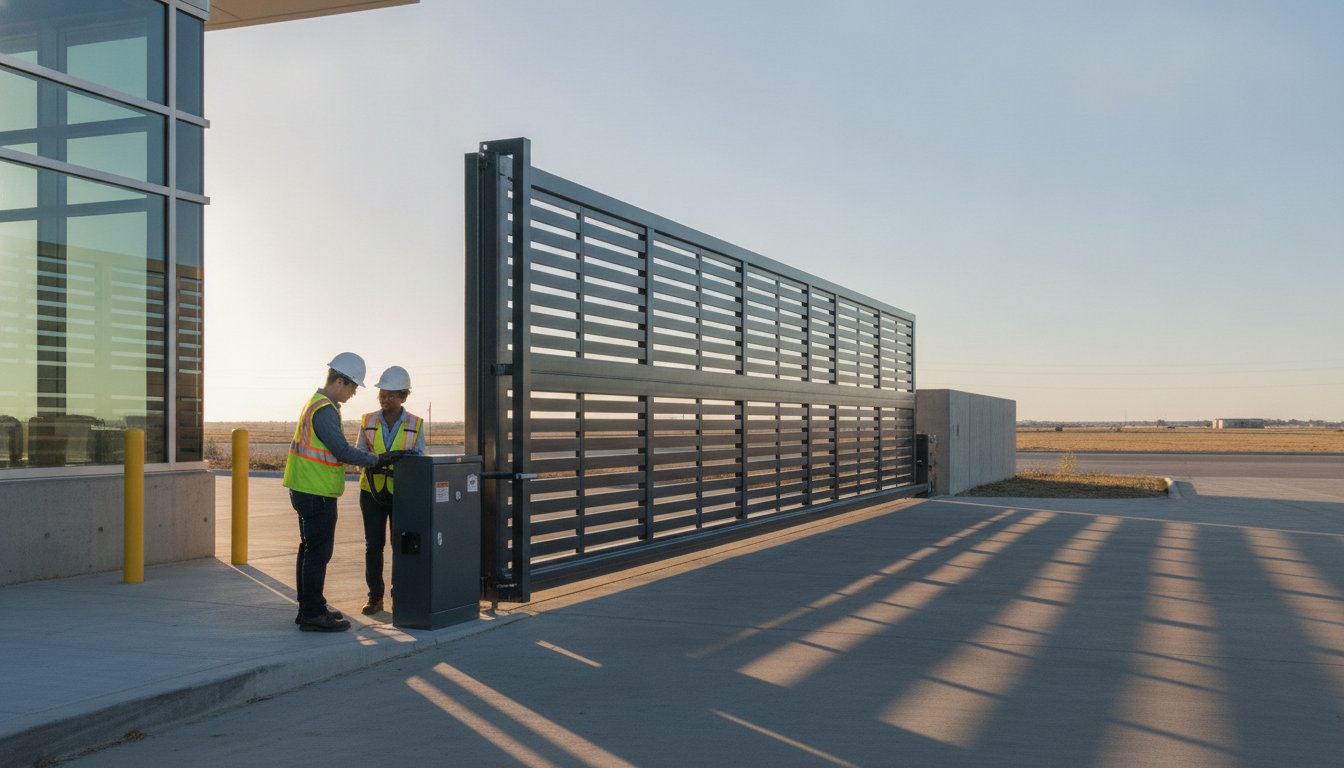
A commercial gate that sags, drags, or stops mid-cycle isn't just a mechanical failure. It's a liability. In North Texas, the combination of expansive Blackland Prairie clay and high wind loads destroys standard gate systems within a few years. Most property managers find themselves trapped in a cycle of frequent repairs because the initial build ignored the physics of the Dallas landscape. You deserve a perimeter that stays plumb and operational without constant technician visits.
We understand that a secure entry is the backbone of your facility's safety. This technical guide masters the requirements for a high-performance commercial gate installation in Dallas, focusing on the engineering that keeps a system running under heavy use. You'll learn how to navigate the 7th edition of UL 325 safety standards to eliminate entrapment risks and protect your business from legal exposure. We will also detail the necessity of in-house galvanized steel fabrication and why deep-set footers are the only way to combat soil shifts. From structural design to the integration of professional-grade operators, this is how you build for long-term reliability.
Key Takeaways
- Understand why North Texas clay and high wind loads demand specialized structural engineering to prevent sagging and mechanical failure.
- Learn why galvanized steel fabrication is the professional standard for longevity compared to standard painted iron.
- Compare the mechanical advantages of slide and cantilever systems to select the right workhorse for your logistics or warehouse yard.
- Master the technical requirements for a compliant commercial gate installation in Dallas, including UL 325 entrapment protection to mitigate legal liability.
- Discover why a single-team approach from shop fabrication to site installation ensures a reliable, secure perimeter.
Why Standard Gates Fail in Dallas Commercial Environments
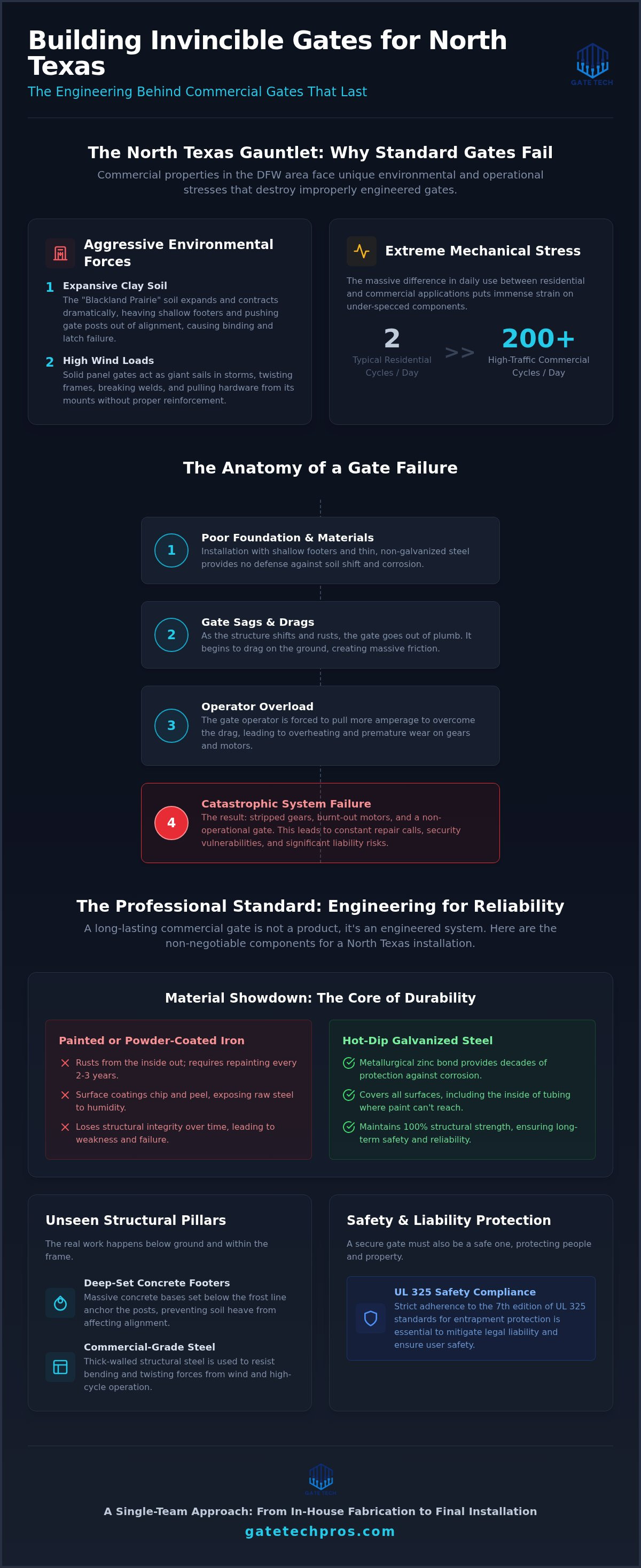
Commercial gates aren't just larger versions of residential ones. They're industrial machines. A standard residential gate might cycle twice a day; a logistics hub in the Metroplex might cycle its entry 200 times in the same period. That's a massive difference in mechanical stress. When a commercial gate installation Dallas project treats a high-traffic entry like a decorative backyard fence, the system will fail. It's inevitable. Most failures we see stem from a fundamental misunderstanding of the "North Texas Factor," which combines aggressive soil movement with intense environmental loads.
The Impact of High-Traffic Cycles
Calculating daily cycles is the first step in engineering a reliable system. A retail center with constant visitor flow requires different hardware than a private warehouse. If you install a light-duty operator designed for low-frequency use, the internal gears will likely strip or the motor will burn out within 12 months. The heat friction alone destroys undersized components. Longevity depends on heavy-duty, sealed-bearing hinges and greaseable pivot points that can handle the constant friction of 100-plus cycles daily. Without these, the gate begins to sag. A sagging gate creates drag, forcing the operator to pull more amperage than it was built to handle. This chain reaction turns a minor alignment issue into a total system replacement.
Environmental Stressors in North Texas
The Dallas-Fort Worth area sits on Blackland Prairie expansive clay. This soil is a gate killer. It expands when wet and shrinks during our frequent droughts, causing unreinforced footers to heave and tilt. If your posts aren't set deep with a massive concrete base, the gate will eventually go out of plumb. Even a half-inch shift can prevent a latch from catching or cause a slide gate to bind in its tracks. This movement is why we prioritize structural integrity over "ornamental" aesthetics. Commercial-grade structural steel has the wall thickness to resist the bending forces that thin-walled residential tubing can't handle.
Wind load is the other silent destroyer. Solid-panel or high-privacy gates act like giant sails during North Texas storms. Without specific wind load calculations and reinforced frames, these gates twist and pull their own mounting hardware out of the masonry. DFW humidity also creates a constant corrosion risk for raw or poorly coated iron. We've seen "painted" gates rust from the inside out within three years. Galvanization is non-negotiable for any project following professional electric gate safety standards. It provides a metallurgical bond that protects the steel, ensuring the structure remains sound for decades, not just seasons.
Engineering for North Texas: Fabrication and Material Standards
A gate that looks good on day one is easy to find. A gate that remains operational after five years of North Texas heat and wind requires actual engineering. For a commercial gate installation Dallas project to succeed, you have to move past "ornamental" catalogs. Most pre-made kits use thin-gauge steel that can't withstand the lateral pressure of a DFW storm. We use a specialized fabrication process in our Argyle shop to ensure every joint is structurally sound and every span is calculated for the specific physics of its site.
Material choice is your first decision. Raw iron or "powder-coated" steel might look sleek, but they're maintenance traps in the Metroplex humidity. We prioritize galvanized steel because it's the only way to prevent internal oxidation. Galvanization involves dipping the steel into molten zinc, creating a metallurgical bond that won't chip or peel. It's the industry benchmark for Fabrication and Material Standards in structural steel. This coating is essential for structural integrity; it ensures the gate doesn't lose its strength to rust during our wet spring seasons.
- Painted Iron: Requires repainting every 2 to 3 years to stop surface rust.
- Galvanized Steel: Provides decades of protection without structural degradation.
- Internal Protection: Zinc coating reaches the inside of the tubing, where paint can't go.
When planning a commercial gate installation Dallas, business owners often overlook the physics of wind. A solid-panel gate acts like a massive sail. Without proper reinforcement, wind pressure transfers directly to the operator's drive chain or gears. This leads to stripped teeth and burnt-out control boards. We engineer our frames to dissipate this energy through the posts and footers. It's about protecting the expensive electronics by building a frame that can take a punch.
Custom Fabrication for Wide Spans
Large commercial openings often require cantilever systems that clear 30 feet or more. These don't use ground tracks, so they rely entirely on counterbalance math. If the "tail" of the gate isn't weighted and sized correctly, the entire structure will dip, causing the motor to work twice as hard. Our "No Shortcuts" philosophy means we calculate the center of gravity for every custom build. We use heavy-duty, sealed-bearing rollers that don't require constant greasing to stay smooth. If you're planning a new perimeter, our custom gate fabrication shop specializes in these high-performance systems. We bridge the gap between architectural requirements and mechanical reality.
Comparing Commercial Gate Mechanics: Slide, Cantilever, and Pivot
Selecting the wrong gate movement for your property is a recipe for mechanical failure. A commercial gate installation Dallas must account for available space, traffic volume, and the physical condition of the driveway. You can't just pick a style based on aesthetics; the physics of the site dictate the hardware. We evaluate every project based on how many times that gate will move every hour and the level of security required to protect the asset. If the mechanics don't match the mission, the system won't last.
Slide and Cantilever Systems
Slide gates are the standard workhorse for DFW logistics yards and warehouses. They move laterally along a fence line, requiring minimal depth. However, ground-track slide gates have a weakness in dusty North Texas environments. Dirt, gravel, and construction debris collect in the track, creating friction that eventually kills the motor. If your site isn't perfectly level or meticulously clean, you don't want a track-based system. It's a high-maintenance choice that leads to stripped gears.
Cantilever gates are the industrial gold standard. They don't use a ground track. Instead, they're suspended by a counterbalance system. This makes them immune to the "North Texas Factor" of shifting soil and uneven pavement. While they require a larger lateral footprint to accommodate the counterbalance tail, they offer superior reliability. They glide over debris, mud, and ice without binding. For high-security industrial sites, the cantilever is the only choice that guarantees consistent uptime with minimal intervention.
Specialized High-Security Barriers
Vertical pivot gates solve the problem of tight footprints. If you don't have the lateral space for a slide gate to retract, a pivot gate lifts vertically. They're fast and efficient. They're also highly effective for rapid deployment in restricted areas where every second counts. When security is the primary driver, we often integrate crash-rated perimeter systems. These are built to ASTM F2656 standards, with M30 or M50 ratings designed to stop a vehicle in its tracks. These aren't standard gates; they're engineered barriers for government, utility, and high-risk commercial sites.
The mechanics are only half the battle. You have to match the operator to the physical load. We typically install LiftMaster or DoorKing operators depending on the specific mechanical requirements of the build. LiftMaster excels in smart integration and high-cycle reliability for modern facilities. DoorKing is often preferred for its rugged, straightforward mechanical design in heavy industrial settings. We don't use "one size fits all" motors. We specify the operator based on the gate's weight, wind load, and anticipated cycle count to ensure your commercial gate installation Dallas stays operational for the long haul.
Navigating UL 325 Compliance and Advanced Access Control
Safety compliance isn't a suggestion. It's a legal necessity. If your gate isn't UL 325 compliant, it's a liability waiting to happen. For a commercial gate installation Dallas, this means adhering to the 7th edition standards that became effective in 2018. A March 2024 update, effective March 2025, further refined these rules for bifold systems and warning language. These standards dictate how automated gates must behave to prevent entrapment. A non-compliant system doesn't just risk safety; it risks your business's financial stability.
The Anatomy of a UL 325 Compliant Gate
A compliant system requires at least two independent entrapment protection points for every potential hazard zone. This typically involves a monitored photo eye (non-contact) and a reversing edge sensor (contact). If one fails, the system must shut down or default to a "press-to-operate" mode. We don't just "install" sensors. We use professional diagnostics to verify that every sensor is communicating correctly with the control board. Many budget installers bypass these safety features to save time. We don't. Full UL 325 compliance serves as the primary liability shield for Dallas businesses against personal injury claims and legal exposure.
Loop detectors are equally vital for protecting your property. These sensors, buried in the driveway, detect the presence of metal. They prevent the gate from closing on a vehicle, which is the most common cause of commercial gate damage in DFW logistics yards. Proper placement and calibration ensure the system knows exactly where a truck is at all times. It's about preventing the "gate hit" before it happens.
Modern Access Control Integration
Functional excellence extends to how you manage entry. We've moved past simple keypads that require manual code updates. Modern commercial sites in the Metroplex now utilize cloud-based management. Systems like LiftMaster MyQ and DoorKing telephone entry allow property managers to revoke access or monitor logs from a smartphone. For fleet-heavy operations, RFID and long-range readers provide seamless entry without requiring drivers to stop and lean out of their cabs. This improves traffic flow and reduces wear on the gate mechanics by eliminating unnecessary starts and stops.
Configuring these systems requires a specialist who understands both low-voltage wiring and network security. If your current system is glitchy or non-compliant, you need more than a quick fix. You need a technical overhaul. Our team provides complete openers & access control packages that integrate directly with your existing security infrastructure. We ensure your perimeter is secure, compliant, and efficient from the first day of operation.
Executing a Complete Entry Solution: From Shop to Site
A commercial gate installation Dallas project fails when there's a disconnect between the fabrication shop and the field. Many companies buy off-the-shelf kits and force them to fit a site they weren't designed for. We don't operate that way. Our "One Crew" approach ensures the same specialists who welded your frame in our Argyle shop are the ones aligning the operator on-site. This continuity eliminates the communication gaps that lead to sagging gates and burnt-out motors. When the person installing the system understands every weld and structural reinforcement, you get a perimeter that works from day one.
The Gate Tech Pros Installation Workflow
Our process begins with site-specific engineering. We don't guess about soil density or wind loads; we analyze the terrain of your North Texas property before a single piece of steel is cut. Precision welding happens in our controlled shop environment, followed by hot-dip galvanizing to seal the structure against corrosion. On-site, the transition is seamless. We integrate the gate, operator, and sensors as a single unit. This isn't just about bolting hardware to posts. It's about ensuring the geometry of the movement is perfect to minimize friction and maximize the life of your electronic components.
Concrete work is the foundation of reliability. In the DFW Metroplex, shallow footers are a recipe for disaster. We set our posts deep to resist the heaving action of expansive clay. If the foundation shifts even a fraction of an inch, the gate binds. We ensure every footer is sized for the specific weight and height of the gate it supports. We don't take shortcuts with cure times or reinforcement because the foundation is the only thing keeping your gate plumb over the long haul.
Post-Installation Reliability
Commissioning is the final technical hurdle. We don't just flip a switch and leave. Our team tests safety sensor response times, radio frequency signal strength for access control, and motor amperage draws. We also provide hands-on training for your staff. Every facility manager should know how to use manual overrides and follow safety protocols to prevent accidents. It's about empowering your team to handle the system safely during power outages or maintenance windows.
Protecting your capital investment requires a disciplined maintenance schedule. The North Texas environment is brutal on moving parts, from dust in the tracks to heat-stressed control boards. Annual diagnostic checks identify mechanical and electrical wear before they cause a shutdown. If you've inherited a system that's already dragging or failing, a patch job won't fix the underlying engineering. You can learn more about our approach to Professional Gate Repairs: Structural Diagnostics and Mechanical Restoration. We specialize in bringing failing perimeters back to full operational health through methodical, technical restoration.
Secure Your Perimeter with Technical Precision
A reliable gate isn't an accident; it's the result of combining structural engineering with precise mechanical execution. Success requires moving past standard "ornamental" solutions and prioritizing galvanized steel and deep-set footers. This technical approach is the only way to ensure your commercial gate installation Dallas remains a functional asset rather than a recurring repair bill. We handle every step of the process, from in-house Argyle fabrication to the deployment of high-security ASTM F2656 crash-rated systems.
Our team operates as UL 325 safety compliance specialists to protect your business from unnecessary liability and operational downtime. We don't take shortcuts because we've seen exactly what happens when a gate fails under heavy traffic or North Texas wind loads. It's time to build a perimeter that actually stands its ground and operates smoothly for years. Request a Commercial Entry Consultation from Gate Tech Pros to get started on a system built for the long haul.
Frequently Asked Questions
How much does a commercial gate installation cost in Dallas?
Total investment for a commercial gate installation in Dallas varies based on the structural material and automation level. A basic steel swing gate with a keypad represents the entry point, while heavy-duty cantilever systems with advanced access control sit at the higher end of the spectrum. Factors like soil stabilization for Dallas clay and specific wind load engineering also influence the final budget. We focus on providing a durable build that reduces long-term repair expenses.
What is the difference between a slide gate and a cantilever gate?
A slide gate runs on a ground track and requires a level, debris-free driveway. It's a space-saving workhorse for warehouses. In contrast, a cantilever gate is suspended by a counterbalance system and never touches the ground. This makes it superior for uneven terrain or sites where dirt and gravel would frequently jam a track. Cantilever systems are the industrial gold standard for reliability in high-traffic North Texas environments.
What are the UL 325 safety requirements for commercial gates in Texas?
The 7th edition of UL 325 is the governing safety standard for all automated gate operators. It mandates monitored entrapment protection, such as photo eyes and reversing edge sensors. If these sensors fail or are blocked, the system must stop or reverse to prevent injury. Ensuring your commercial gate installation in Dallas meets these federal standards is critical for avoiding liability and keeping your facility compliant with the National Electrical Code.
How long does it take to fabricate and install a custom commercial gate?
The timeline depends on complexity and the municipal permit process. Commercial plan reviews through the "DallasNow" portal typically take 10 to 25 business days. Once permits are secured, our Argyle shop begins fabrication, which involves precision welding and galvanizing. The physical on-site installation usually takes a few days, including footer pouring and electrical integration. We prioritize doing the job correctly over rushing a system that will fail prematurely.
Which gate operator brands are best for high-traffic Dallas businesses?
We specify LiftMaster and DoorKing operators for their proven durability in high-cycle environments. LiftMaster provides excellent cloud-based integration through MyQ, making it ideal for modern facilities requiring remote management. DoorKing is often the preferred choice for heavy industrial sites due to its rugged mechanical design and straightforward maintenance. Selecting a professional-grade operator ensures the motor can handle the weight and wind resistance typical of North Texas commercial properties.
Does a commercial gate require a special permit in the DFW Metroplex?
Commercial installations must be permitted through the Department of Sustainable Development and Construction. You'll need to submit plans that comply with the 2021 International Building Code and local zoning setbacks. Additionally, projects must meet Texas Accessibility Standards (TAS) to ensure proper clearance and operation. We navigate these technical requirements during the planning phase to ensure your perimeter is legally compliant and passes municipal inspections without delays.
Can I integrate my existing security cameras with a new gate system?
Most high-end operators and access control panels now support video integration. You can link your gate system with cloud-based cameras to verify visitor identities before granting access. This creates a unified security layer for your property. We configure telephone entry systems and RFID readers to work alongside your existing surveillance, giving you a complete log of every vehicle that enters or exits the facility through the automated entry point.
What maintenance is required for a commercial automatic gate?
We recommend at least two professional diagnostic checks per year. This includes lubricating heavy-duty hinges, verifying sensor alignment, and checking the tension on drive chains. In Dallas, you must also monitor post alignment as the expansive clay soil shifts. Catching minor mechanical issues early prevents the motor from overworking and burning out. Consistent maintenance protects your capital investment and ensures the gate remains a reliable security barrier.
- commercial gate installation Dallas
Need this done on your property?
Tell us the gate type, what it's doing, and the address.