
Home/Blog/Gate Intercom System Repair: A Master Craftsman’s Guide to Diagnostics
August 22, 2026
Gate Intercom System Repair: A Master Craftsman’s Guide to Diagnostics
Frustrated with your intercom? Learn master diagnostics for gate intercom system repair. Pinpoint root causes from weather to wiring for a truly reliable fix.
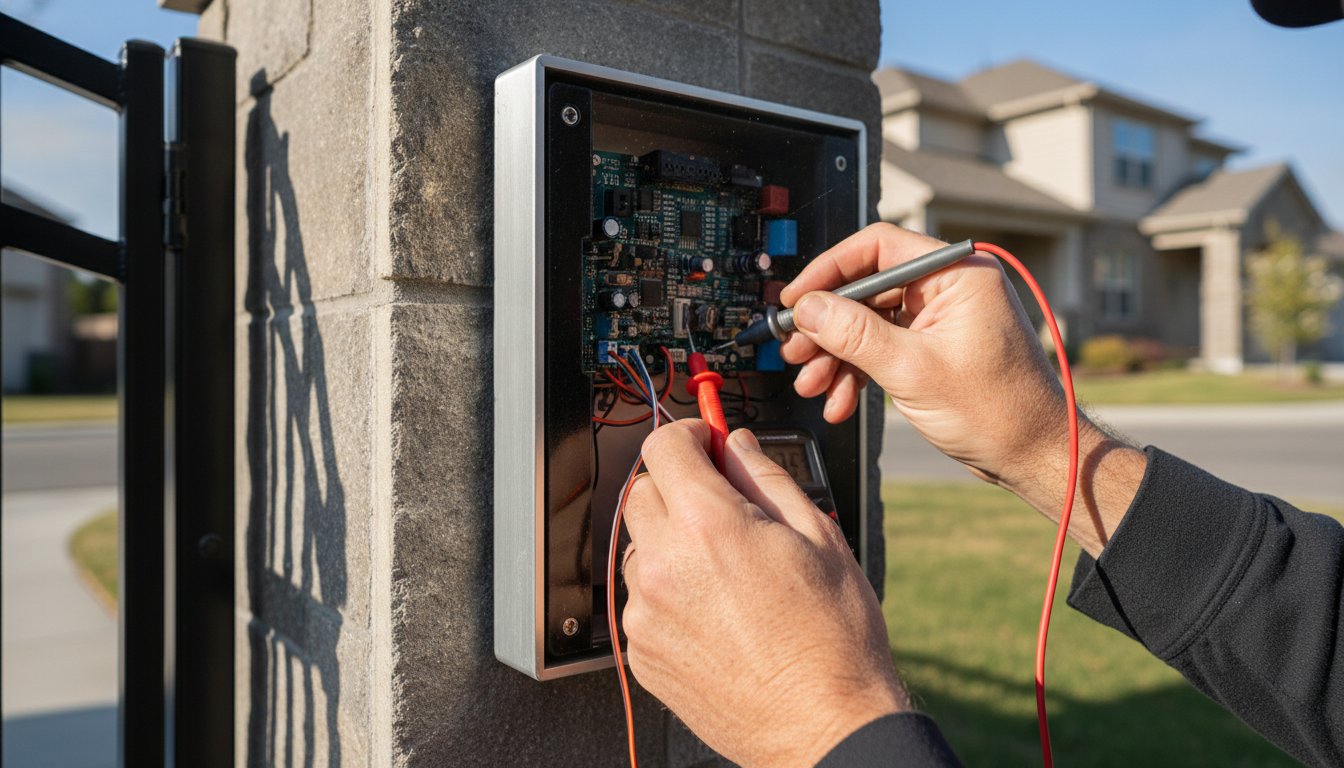
Most "repair" technicians are actually just parts-swappers who hope a new control board fixes the symptom without ever addressing the underlying disease. It's a waste of your time and money. When you're dealing with a faulty gate intercom system repair, you need a specialist who understands the common challenges that compromise these systems, from harsh weather conditions and ground instability to persistent wear and tear. It's frustrating when you're stuck with intermittent signal loss or audio so distorted it’s useless. You expect your security system to work every time, not just when the hardware feels like cooperating.
This guide moves beyond superficial fixes to show you how a master craftsman approaches diagnostics by hunting down the true root causes of failure. We won't just talk about swapping units; we’ll focus on the technical rigor that restores total security to your property. You'll learn how to identify pest damage in internal circuitry and why weather-hardened hardware is non-negotiable. We'll preview the professional steps required to achieve clear audio communication and seamless integration with your existing access control systems like LiftMaster or DoorKing.
Key Takeaways
- Identify how North Texas heat affects solder joints and circuit board longevity in outdoor access systems.
- Discover why a master craftsman prioritizes deep diagnostics for gate intercom system repair rather than simply swapping out expensive components.
- Learn to trace signal failures between the master station and entry point to pinpoint the exact source of audio distortion.
- Evaluate the benefits of galvanized steel enclosures and industrial-grade gaskets for preventing moisture and pest infiltration.
- Understand the logical troubleshooting steps for verifying power supplies and physical terminal connections to avoid unnecessary hardware replacements.
Understanding Gate Intercom Failures in North Texas
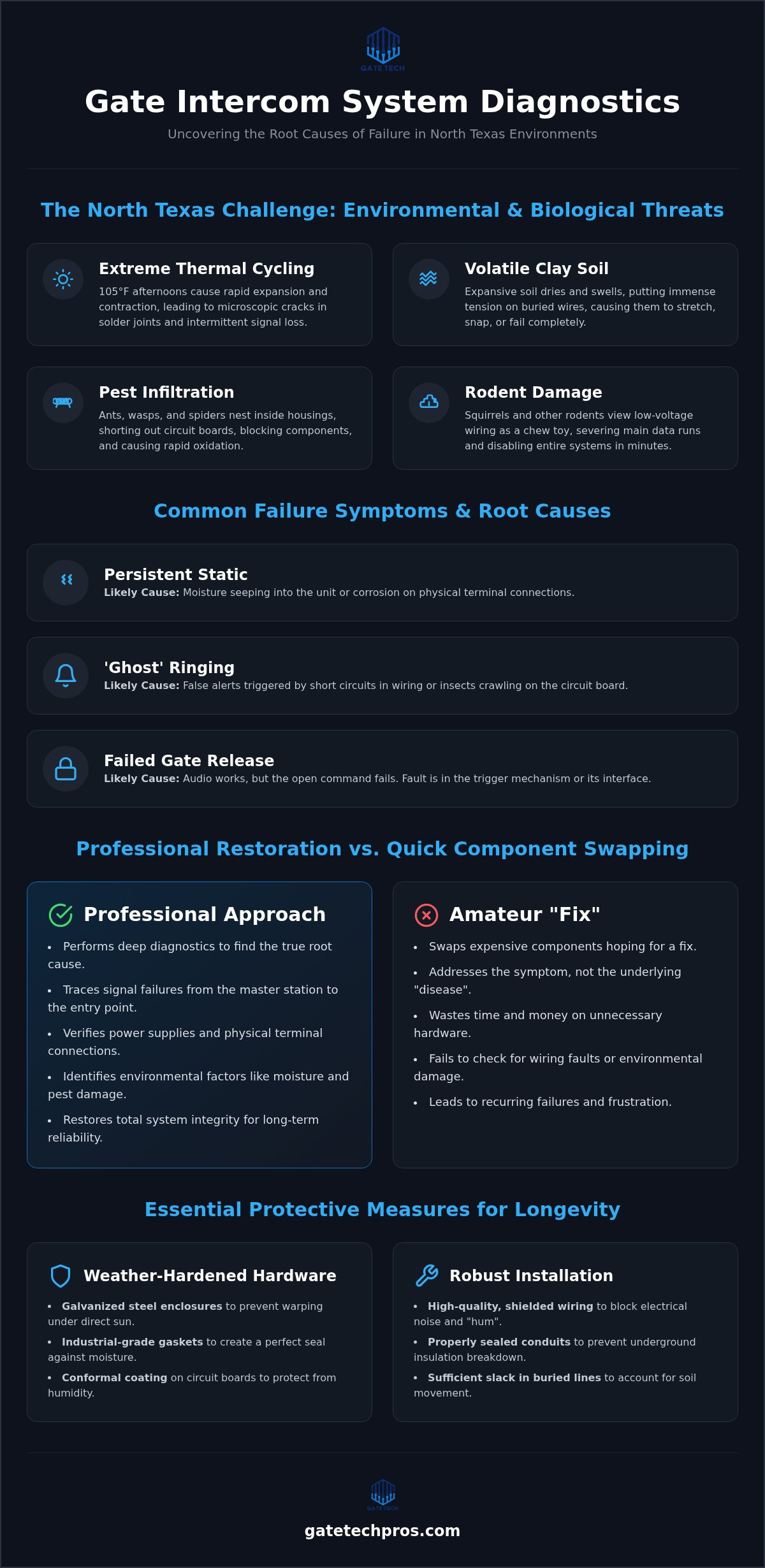
Effective gate intercom system repair starts with a simple reality: the environment is trying to kill your electronics. In its simplest form, this repair process involves diagnosing why communication has ceased between the visitor at your entry point and the receiver in your home or office. It isn't just about a "broken button." It's about a failed signal chain. Modern intercom technology relies on delicate voltage thresholds that North Texas conditions aggressively disrupt.
Our local environment presents two unique challenges: extreme thermal cycling and volatile soil. When temperatures swing from freezing nights to 105-degree afternoons, components inside your intercom housing expand and contract rapidly. This mechanical stress causes microscopic cracks in solder joints, leading to intermittent signal loss. This is why a system might work in the morning but fail by 2:00 PM. Simultaneously, the expansive clay soil in Argyle and the surrounding DFW area acts like a slow-motion vice. As the ground dries and swells, it puts immense tension on buried communication lines. If the original installer didn't account for this movement, those wires eventually stretch to the point of failure or snap entirely.
Common indicators of a failing system include:
- Persistent static: Usually caused by moisture ingress or terminal corrosion.
- 'Ghost' ringing: Often triggered by short circuits in the wiring or insect activity on the board.
- Failed gate release: The audio works, but the command to the operator never arrives.
Environmental Stressors: Heat and Humidity
Standard consumer-grade electronics aren't built for Texas. Most off-the-shelf units use plastic housings that warp under direct sunlight. This warping breaks the seal of the unit, allowing North Texas humidity to seep in. Once moisture hits a hot circuit board, it creates a conductive film that leads to "bridging" between components. This results in erratic behavior or a total system blackout. We see this often with hardware that wasn't designed for industrial-grade outdoor use. High-end systems utilize conformal coating on boards to prevent this, but cheaper units leave the copper exposed to the elements.
Biological Interference: Pests and Debris
Your intercom housing is a perfect, climate-controlled sanctuary for local pests. Ants are particularly attracted to the electromagnetic fields of live circuit boards. They crawl inside, nest, and eventually short out the entire system with their own bodies. Wasps often build nests in the gaps of poorly sealed enclosures, blocking speakers and microphones. Even spiders play a role; their webs trap moisture against sensitive pins, causing rapid oxidation. Finally, rodents view low-voltage wiring as a chew toy. A single squirrel can take down a complex access control system in minutes by severing the main data run.
Anatomy of a Professional Entry System
Understanding the physical architecture of your access control is the first step toward effective gate intercom system repair. A professional system functions as a closed loop. It begins at the sub-station, which is the call box visitors interact with at your gate, and terminates at the master station inside your property. The critical bridge between these two points is the trigger mechanism. This is a physical relay or digital command that instructs the gate operator's control board to cycle the motor. If your audio works but the gate won't open, the fault usually lies in this specific interface. For issues directly related to the drive system, see our guide on automatic gate motor troubleshooting.
Wired Intercom Systems: Reliability at a Distance
Hardwired systems remain the gold standard for high-security sites because they eliminate the volatility of airwaves. They rely on physical copper paths. Reliability here depends on proper wire gauge and high-quality shielding. Without shielding, electrical noise from nearby power lines can bleed into the audio, creating that characteristic "hum" or buzz. Professional installations adhere to strict industry testing and certification standards to ensure signal integrity over long distances. Common failures in these systems often stem from ground loops or insulation breakdown caused by poor conduit sealing. We frequently find that "mystery" audio issues are actually the result of nicked wires that have begun to oxidize underground.
Wireless and IP-Based Systems
Modern properties often opt for Wi-Fi bridges or cellular modules to avoid the cost of trenching new wire. These IP-based systems offer smartphone integration and video calling, but they introduce new failure points. RF interference from neighboring networks or physical obstructions like heavy foliage can cause signal drops. Security is another factor. An unencrypted IP intercom is a vulnerability. Troubleshooting these requires verifying network stability and checking for firmware conflicts between the intercom and the router. If your system feels unreliable, consulting a specialist for a signal strength audit can prevent a total lockout. We focus on hardening these systems against local interference to ensure the "smart" features don't become a liability.
Troubleshooting Common Intercom Malfunctions
A master craftsman doesn't guess. He measures. Professional gate intercom system repair is a process of elimination, not a series of expensive component swaps. If your system is failing, the problem is rarely the entire unit. It is usually a single point of failure in the signal chain that has been compromised by environment or age. You must isolate the hardware from the environment to find the truth.
Follow this logical framework to identify the break in your system:
- Verify power supply: Test both the master station and the call box with a multimeter. Don't assume the outlet is live. Check for steady 12V or 24V DC voltage.
- Inspect terminal connections: North Texas humidity creates a corrosive "crust" on copper. Clean the contacts and tighten the screws to ensure a low-resistance path.
- Test the audio circuit: Verify the speaker and microphone independently. If the board doesn't process sound at the source, the communication lines are irrelevant.
- Check for interference: Look for high-voltage AC lines running parallel to your low-voltage runs. Metal structures can also act as antennas for RF noise, causing a constant 60Hz hum.
- Isolate the automatic gate actuator: Disconnect the trigger wires at the motor. If the motor cycles with a local jumper, the fault is in the intercom relay or the underground wire run.
Diagnosing Audio Issues: Static and Silence
Silence is usually a hardware failure. Static is an environmental failure. If you have no sound at all, check for a blown speaker or a disconnected microphone lead. Static and buzzing are different. Buzzing usually comes from poor shielding or ground loops. Static often points to moisture sitting on the circuit board or a failing capacitor. In multi-tenant environments, you may encounter cross-talk. This happens when wire insulation breaks down and signals bleed between pairs. It's a wiring issue, not a hardware issue. Adjusting the gain can sometimes tune out feedback squeals, but it's a temporary fix for a deeper acoustic or electrical problem.
Failure to Open: The Trigger Circuit
The intercom is a remote switch. Nothing more. When the audio works but the gate won't budge, the trigger circuit has failed. Check the relay for continuity using your meter. If the relay clicks but the gate doesn't move, the signal isn't reaching the operator. Test for voltage drops during the trigger command. An aging transformer might provide enough power for audio but fail when the relay tries to pull. This is especially true for systems integrated with magnetic locks or heavy-duty strike plates. If the voltage dips below 80% of its rating during the cycle, your power supply is the bottleneck. Fix the power, and you fix the gate.
Weatherproofing and Pest Mitigation Strategies
Standard weatherproofing is a myth in North Texas. If your strategy involves a simple bead of caulk and a prayer, your system is already failing. Effective gate intercom system repair requires a proactive hardening of the hardware before the environment forces a shutdown. We don't just fix the break; we build for the environment. This means choosing materials that survive the brutal cycle of sun, wind, and invasive pests that define our region.
The first choice is the material of the enclosure itself. Choose galvanized steel, not standard aluminum. Aluminum is lightweight and cheap to ship, but it lacks the thermal stability required for our 105-degree August days. Galvanized steel provides the structural rigidity necessary to maintain a waterproof seal as the metal expands and contracts. Inside that enclosure, industrial-grade gaskets are mandatory. We don't rely on hardware-store silicone. We use compression-rated seals that block moisture even when the pressure changes during a storm.
Internal condensation is a silent killer. Even a perfectly sealed box will "sweat" as temperatures fluctuate. We implement precision weep holes at the lowest point of the enclosure. These holes allow internal moisture to drain out rather than pooling on the circuit board. To further protect the electrical path, we apply dielectric grease to every terminal connection. This non-conductive grease creates a physical barrier against oxygen and moisture. It prevents the copper oxidation that leads to signal loss and "ghost" ringing. It's a small step that most technicians skip, but it's the difference between a two-year fix and a ten-year solution.
Structural Protection: Hoods and Bollards
Horizontal rain is a reality in North Texas. When the wind hits 50 mph, a standard rain hood becomes purely decorative. You need deep-recessed enclosures that keep the speaker and microphone dry regardless of wind direction. Beyond the weather, you must account for physical impact. We recommend protecting call boxes with heavy-duty steel bollards. A distracted driver or a delivery truck shouldn't be the end of your security system. Integrating the intercom into a custom-fabricated, heavy-gauge steel pedestal ensures the unit remains upright and functional for the long haul.
Electrical Shielding and Surge Protection
Lightning is a constant threat in the DFW area. Without industrial-grade surge suppressors, a nearby strike will fry your sub-station and master station instantly. Proper grounding is not optional; it is the foundation of electrical safety. We use rigid conduit for all underground wire runs to prevent rodent damage. Squirrels and field mice view low-voltage insulation as a food source, but they can't bite through steel. If your current setup looks vulnerable to the elements, contact us for a professional hardware audit to harden your perimeter against the Texas climate.
Professional Restoration vs. Quick Component Swapping
Lazy technicians rely on part-swapping. They replace a control board, collect a check, and leave before the underlying wiring fault fries the new hardware. This isn't gate intercom system repair; it's an expensive gamble with your security. A master craftsman understands that a failed component is often just the final symptom of a deeper issue. True restoration requires a full diagnostic sweep of the electrical signal path and the physical environment. If we don't address the moisture ingress or the rodent-damaged conduit, the new part will fail just like the old one did.
Deciding whether to repair or replace often comes down to the "50% rule." If the cost of a complex repair approaches half the price of a new, modern telephone entry system, we recommend an upgrade. Technology moves fast. Older analog systems lack the smartphone integration and IP-based security features that define the 2026 market. However, if the core hardware is sound, we focus on mechanical and electrical restoration to extend the system's lifespan without unnecessary capital expenditure.
The Gate Tech Pros Difference
We operate an in-house fabrication shop in Argyle. This allows us to build custom mounting solutions and structural reinforcements that standard "repair" companies simply can't provide. Our team specializes in professional-grade hardware from industry leaders like DoorKing and LiftMaster. We don't use shortcuts. Every wire is terminated correctly; every enclosure is sealed to industrial standards. We take pride in self-reliance. This means we handle everything from the initial voltage test to the final structural weld ourselves. You get a single, accountable crew that understands the nuances of your specific access control architecture.
Commissioning and Safety Testing
A repair isn't finished until the system is verified for safety. We ensure that every gate intercom system repair maintains strict UL 325 gate safety compliance. This involves testing the integration between your intercom and entrapment protection devices like photo eyes and loop detectors. If your intercom command bypasses a safety sensor, your property is a liability. We don't allow that.
The final phase of our process is rigorous commissioning. We test audio clarity at the gate, verify the remote trigger reliability from the master station, and check signal strength on IP-based modules. Once the hardware passes our internal benchmarks, we provide the property owner with a detailed diagnostic report. You'll see exactly what was fixed, why it failed, and what steps we took to prevent a recurrence. We believe in functional excellence. We deliver a system that works predictably, every time someone presses the call button.
Hardening Your Access Control Against the Texas Climate
A reliable intercom is the first line of defense for your property. It requires more than just a functioning circuit board; it needs structural integrity and aggressive environmental protection. Successful gate intercom system repair depends on identifying how local heat and soil movement degrade your signal path. By choosing galvanized steel enclosures and industrial-grade sealing, you move past temporary fixes toward long-term functional excellence. Don't settle for technicians who guess at the problem when you can have a solution built for the long haul.
At Gate Tech Pros, we leverage our Argyle-based fabrication shop to build systems that survive North Texas extremes. We don't just swap parts. We verify every repair against UL 325 safety standards to ensure your system remains compliant and secure. Our team brings direct experience with the unique stressors of our region to every diagnostic call. We take pride in doing the job correctly the first time. Schedule a Master Craftsman’s Diagnostic for Your Gate Intercom to restore precision to your perimeter. Your security shouldn't be a gamble; it should be a certainty.
Frequently Asked Questions
Why is there static on my gate intercom audio?
Static is usually caused by moisture ingress or terminal oxidation. North Texas humidity creates a conductive film on circuit boards, leading to "bridging" between components. Poor shielding on wired runs can also introduce electrical noise from nearby AC lines. We solve this by cleaning terminals and applying dielectric grease. If the static persists after cleaning, the problem is likely a failing capacitor or compromised wire insulation underground.
Can I repair a gate intercom myself?
Most homeowners can check for power or clean debris, but complex gate intercom system repair requires specialized tools. You need a multimeter to trace voltage drops and signal continuity. Attempting to rewire a board without understanding relay logic can lead to a total system short. Professional diagnostics identify the root cause, such as soil shift affecting buried lines, which DIY efforts usually miss. It's about precision, not just part-swapping.
How much does it cost to repair a gate intercom system?
Repair costs depend entirely on the diagnostic findings and the complexity of the failure. A simple terminal cleaning is far less intensive than replacing a lightning-damaged control board or trenching new communication lines. We focus on restoring functional excellence rather than just selling new hardware. If a repair exceeds half the value of a modern unit, we provide a transparent assessment of the long-term benefits of an upgrade versus a restoration.
What are the most reliable intercom brands for North Texas?
DoorKing and LiftMaster are the most reliable choices for the North Texas environment. These manufacturers build hardware designed for industrial-grade outdoor use, featuring robust enclosures and high-quality circuit protection. We specialize in these brands because they offer the durability needed to survive 100-degree summers. Their components are readily available, making future maintenance straightforward. Choosing professional-grade hardware ensures your system integrates seamlessly with existing gate operators and safety devices.
Why does my gate open for some people but not others?
This issue usually stems from a failing relay or a weak power supply. Some users might trigger a slightly higher voltage command from their handset, while others fall just below the threshold required to trip the motor. It can also involve intermittent signal loss caused by pest damage to specific internal pins. We trace the signal path to ensure the trigger command is consistent across all receiving stations to prevent these frustrating lockouts.
Can a wireless intercom work through a heavy metal gate?
Wireless signals struggle to penetrate heavy metal gates because the steel acts as a Faraday cage. This interference leads to dropped calls and failed gate triggers. To solve this, we mount external antennas or use Wi-Fi bridges that bypass the physical obstruction. Reliability in these scenarios depends on a clear line of sight between the transmitter and receiver. For high-security sites, hardwired connections remain the gold standard for avoiding RF signal degradation.
What happens if my intercom system is no longer manufactured?
If your hardware is obsolete, we evaluate if the existing wiring can support a modern telephone entry system. Many legacy systems use proprietary communication protocols that aren't compatible with current hardware. We don't just abandon the system; we look for ways to adapt the structural mounts and conduit for a modern upgrade. This approach saves on installation costs while providing you with updated features like smartphone app integration and better weatherproofing.
How often should a gate intercom be professionally inspected?
You should have your system professionally inspected at least once a year. In North Texas, the extreme thermal cycling between seasons puts immense stress on solder joints and gaskets. A professional check includes cleaning terminal contacts, verifying power levels, and ensuring no pests have nested inside the housing. Regular maintenance prevents a minor oxidation issue from turning into a total system failure during a storm or a critical security event.
- gate intercom system repair
Need this done on your property?
Tell us the gate type, what it's doing, and the address.