
Home/Blog/Commercial Gate Maintenance Plan: Protecting Your Perimeter Investment in 2026
August 20, 2026
Commercial Gate Maintenance Plan: Protecting Your Perimeter Investment in 2026
Protect your property with a 2026 commercial gate maintenance plan. Learn to ensure UL 325 compliance, mitigate liability, and extend equipment life in Texas.
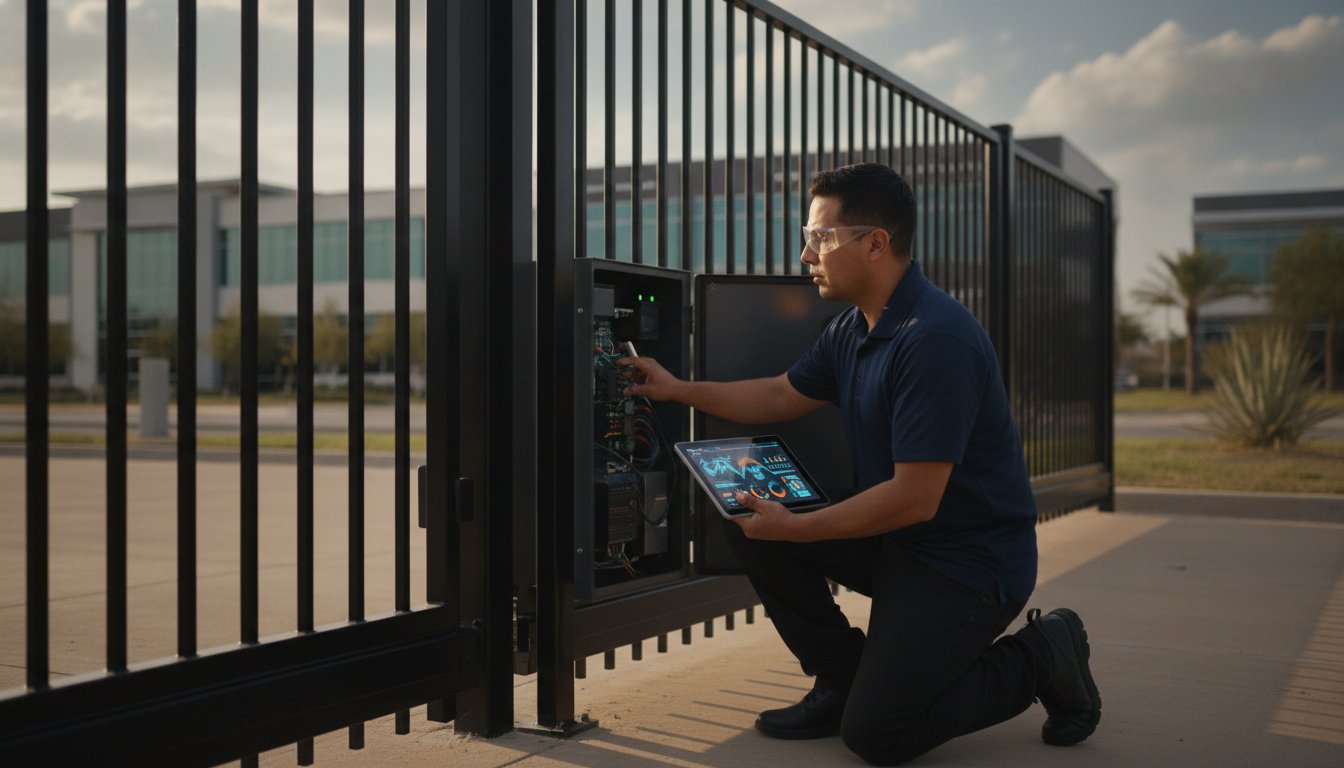
What if your perimeter security is actually your biggest legal liability? For North Texas property managers, a gate that fails to reverse or stops mid-cycle isn't just a nuisance. It is a direct threat to your bottom line and your safety record. You already know that unpredictable repair costs and frequent downtime disrupt your daily operations. Implementing a structured commercial gate maintenance plan is the only way to move from reactive firefighting to a predictable operational budget. It is about protecting a high-value asset before it becomes a liability.
This guide provides a professional roadmap to maximizing equipment lifespan while ensuring documented UL 325 and ASTM F2200 compliance. We will explore how to verify safety standards, integrate 2026 technologies like cellular access, and meet specific local requirements like the McKinney Fire Code. You will see how a methodical approach to maintenance extends equipment life and keeps your facility running without the burden of expensive surprises. We focus on the technical realities of gate ownership, providing you with the facts needed to maintain a safe, functional, and compliant property.
Key Takeaways
- Shift from reactive repairs to a documented safety protocol that mitigates legal liability and ensures UL 325 compliance.
- Learn how North Texas clay soil and extreme summer heat specifically impact gate alignment and hydraulic fluid performance.
- Establish a structured commercial gate maintenance plan that balances frequent visual checks with professional technical diagnostics.
- Identify high-wear components like hinges, rollers, and motor gearboxes to prevent sudden operational failures and costly downtime.
- Understand why shop-built fabrication expertise is critical for verifying the structural integrity of crash-rated and galvanized steel systems.
Beyond Functionality: Maintenance as a Liability and Safety Shield
A commercial gate is a moving wall of steel. While it provides essential perimeter security, it's also a piece of heavy machinery. If that machinery fails, the consequences aren't just mechanical. They're legal. For North Texas HOAs and business owners, a commercial gate maintenance plan serves as a documented safety protocol. It's the difference between a minor adjustment and a catastrophic insurance claim.
Many property managers believe that "greasing the wheels" is enough. It isn't. Modern liability protection requires more than just lubrication. You need a defensive maintenance strategy that prioritizes verifiable safety data over superficial fixes. Industry shortcuts often skip the testing of safety sensors. We don't. We treat every inspection as a diagnostic verification of the entire system's integrity. It's about proving the gate is safe before an accident happens.
The Critical Role of UL 325 Compliance
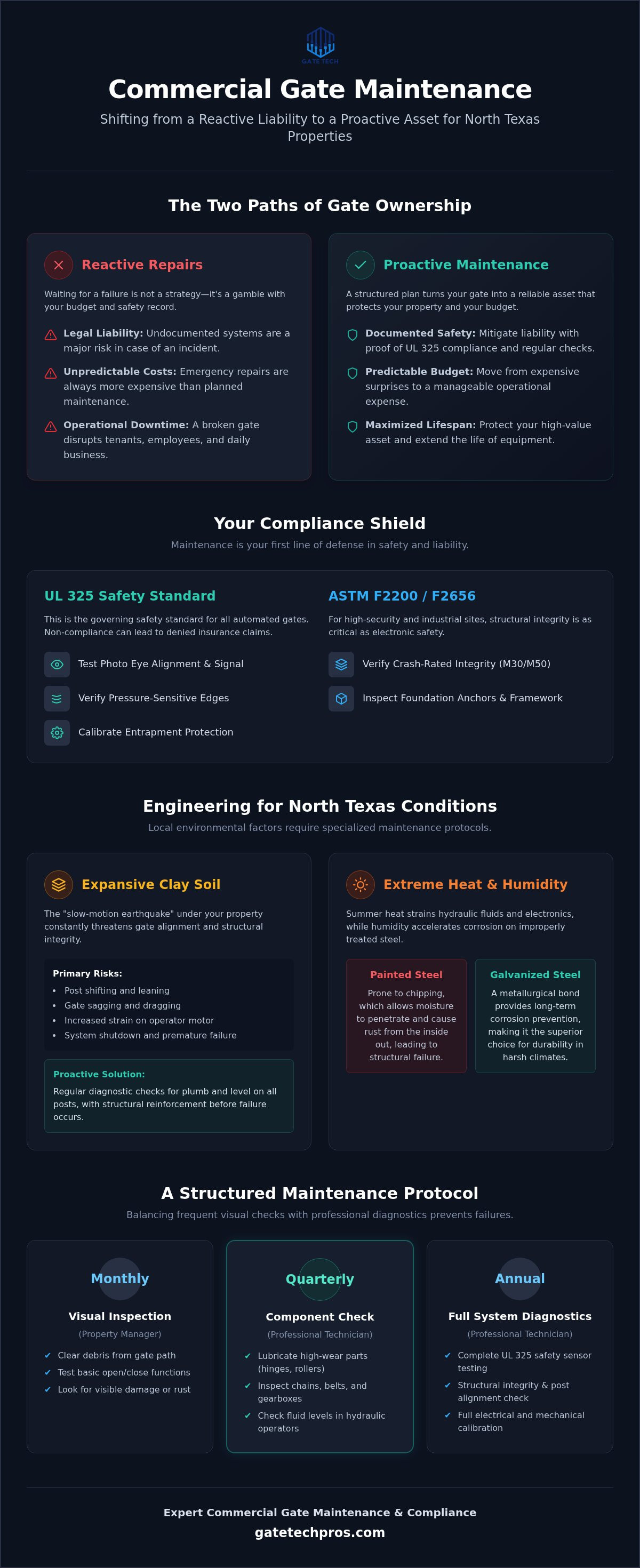
UL 325 is the governing safety standard for automated gate operators. The 7th edition, effective since August 2018, remains the baseline for our inspections. A March 2024 update, which became effective in March 2025, added specific provisions for bifold gates and updated warning language requirements. Compliance isn't optional. It's a shield during insurance audits and legal claims. Our protocol includes:
- Testing photo eyes for correct beam alignment and signal strength.
- Verifying that pressure-sensitive edge sensors trigger an immediate reverse on contact.
- Ensuring all inherent entrapment protection systems are calibrated to the correct sensitivity.
If an injury occurs and your gate lacks documented safety checks, your insurance company can deny the claim. We verify that every operator meets these rigorous standards and provide the documentation to prove it.
ASTM F2656 Standards for High-Security Sites
Industrial and government facilities often rely on crash-rated systems to protect critical assets. These M30 and M50 rated gates are engineered to stop a vehicle, but they only work if the structural integrity is maintained. High-security environments demand specialized mechanical verification that goes beyond standard commercial checks. We don't just look at the motor; we inspect the foundation anchors and the internal framework of the gate itself. A crash-rated gate that's out of alignment due to North Texas soil shifts won't perform under high-stress conditions. We ensure the hardware is capable of meeting ASTM F2656 requirements through every cycle.
Engineering for North Texas: Weather, Soil, and Structural Wear
While conditions vary by region, areas with aggressive geology, such as the expansive clay soil common in places like North Texas, can act like a slow-motion earthquake, constantly shifting the foundations of your perimeter security. A commercial gate maintenance plan must account for local soil conditions to prevent premature failure. We don't just look at the motor; we analyze the physics of the entire opening, understanding how environmental factors impact performance.
Beyond soil, extreme heat and humidity, common in many regions, create a brutal environment for mechanical and electronic components. Standard painted gates quickly succumb to these conditions. They chip, they rust, and they fail. At Gate Tech Pros, we understand the importance of durable materials, often recommending solutions like galvanized steel gates. Unlike painted alternatives, galvanized steel provides a metallurgical bond that prevents corrosion from the inside out. It's a "this, not that" reality: you either build for the environment or you pay for constant repairs. If your current system is showing signs of wear, our expert diagnostics can identify whether the issue is structural or mechanical before it becomes a total failure.
Soil Shifting and Post-Leveling Diagnostics
Expansive clay soil, common in many regions, expands when wet and contracts when dry. This movement is a primary cause of sagging in driveway gates. When a post shifts even a fraction of an inch, the leverage at the end of a 20-foot gate leaf is massive. It creates drag, strains the operator, and eventually causes a system shutdown. Our service visits prioritize checking plumb and level on every post. If we catch early signs of sag, we can implement structural reinforcement techniques, such as deeper footings or cross-bracing, to stabilize the system. This proactive approach helps maintain compliance with industry safety standards by ensuring the hardware doesn't bind or fail under pressure.
Thermal Expansion and Electronic Stress
Heat expansion doesn't just affect the metal. It changes the viscosity of hydraulic fluids in actuators, making them sluggish or prone to leaks. Even more critical is the impact on electronics. Unventilated operator housings can reach extreme temperatures, effectively boiling the control boards. This leads to erratic behavior or complete access control failure. A robust commercial gate maintenance plan includes verifying the integrity of seals and ensuring sensitive electronics are shielded from direct sun exposure and harsh environmental conditions. We check for heat-damaged capacitors and verify that cooling fans or vents are clear of debris. Protecting these systems now prevents the "fried board" emergency that disrupts your business operations.
Critical Systems in a Professional Maintenance Protocol
A comprehensive commercial gate maintenance plan isn't a checklist of chores. It's a technical audit of four distinct systems: mechanical hardware, operator mechanics, access control, and safety sensors. If one fails, the entire perimeter is compromised. We focus on physical verification. This means testing the actual torque of the motor and the precise alignment of the tracks, not just looking at them. We diagnose the "why" behind a sluggish gate rather than just treating the symptom.
The operator is the heart of the system. We inspect motor health by checking for brush wear and electrical resistance. Gearboxes require oil level checks to prevent metal-on-metal grinding. We also test limit switches to ensure the gate stops exactly where it should. A gate that overtravels puts unnecessary stress on the frame and the motor, leading to premature failure. We verify these tolerances to ensure the machine isn't fighting itself during every cycle.
Mechanical Restoration and Lubrication
Using standard WD-40 on a commercial gate is a mistake. It's a solvent that evaporates quickly and attracts North Texas dust, creating an abrasive paste that grinds down your bearings. We use high-pressure, water-resistant lubricants designed for heavy-duty pivot points and cantilever rollers. These rollers carry the entire weight of the gate. If they bind, the motor has to work twice as hard, shortening its lifespan. For properties with existing damage, we provide Professional Gate Repairs to restore structural integrity before applying a maintenance schedule.
Access Control and Signal Verification
Access control is often the most frustrating point of failure for property managers. We troubleshoot common issues like antenna interference and receiver degradation. For multi-unit HOA sites, we test telephone entry systems to ensure clear audio and reliable relay triggers. This includes verifying RFID ranges for "hands-free" entry. If your residents have to wave their tags at the reader, the system isn't calibrated correctly. We also update access codes and purge old credentials to maintain security, ensuring your commercial gate maintenance plan covers the digital perimeter as well as the physical one.
Safety devices require the most precise calibration. We test loop detectors to ensure they detect vehicles but ignore small metal debris. Photo eyes must be aligned to the millimeter to prevent false triggers. Finally, we verify the emergency release. In a power failure or fire emergency, your gate must open manually without a struggle. We ensure the clutch or bypass lever is functional and easy to operate, protecting you from both operational downtime and safety liability.
Strategic Maintenance Scheduling: Monthly, Quarterly, and Annual
A commercial gate maintenance plan must be scaled to the actual workload of your property. A gated community with 500 daily cycles requires a different rhythm than a low-traffic industrial warehouse. We establish a hierarchy that prevents over-servicing while ensuring zero-gap protection. This structured approach moves your facility away from emergency repairs and toward a predictable operational budget. We focus on the high-wear components that fail first when ignored.
- Monthly: Perform visual safety checks and clear debris from sliding tracks. In North Texas, wind-blown gravel and organic material can derail a gate or cause a motor to overheat from excess friction.
- Quarterly: Execute deep lubrication of heavy-duty pivot points and cantilever rollers. This visit includes tightening all mechanical hardware and stress-testing battery backup systems to ensure operation during DFW power fluctuations.
- Annual: Conduct a full system diagnostic. This includes a structural weld inspection, a formal UL 325 safety certification, and an audit of the operator control board health.
The High-Traffic Maintenance Adjustment
High-density HOAs and industrial logistics centers can't afford a "wait and see" approach. If your gate cycles more than 100 times a day, your maintenance schedule must accelerate to match the mechanical wear. Watch for early warning signs like grinding noises during the start-up phase or a three-second delay in response times. These are precursors to a mechanical seizure. The ROI of frequent service is found in the costs you don't pay. Preventing a stuck-open gate at a secure facility saves thousands in temporary security guards and lost productivity. If your system is already showing these signs, you need to schedule a commercial gate maintenance plan to stabilize your perimeter before a total failure occurs.
Annual Structural and Electrical Audit
Once a year, we go deep into the operator control board. We check for heat-damaged circuits and verify that the system's sensitivity settings haven't drifted. We also inspect the physical gate frame. While our shop-built galvanized steel gates are designed to resist corrosion, we still verify the integrity of the coating and look for hidden stress fractures in structural welds. Finally, we stress-test entrapment protection systems to ensure zero-fail performance. This documented audit is your primary defense against liability claims and insurance audits. It proves your equipment is maintained to professional standards.
Implementing a Gate Tech Pros Maintenance Plan
Most service companies act as middle-men. They buy a gate, install it, and hope for the best. We don't. We build the gates in our own shop. This "Shop-Built" advantage means we understand the structural engineering behind every hinge and weld. When you start a commercial gate maintenance plan with us, you're hiring the people who actually know how the machine was put together. We don't guess. We verify.
Our diagnostic process is a three-tier audit: Mechanical, Electrical, and Safety. We check for structural fatigue, test the electrical draw of the motor, and verify every safety sensor against current standards. This comprehensive approach is the foundation of our Complete Entry Packages. By managing the gate, the operator, and the access control as a single unit, we simplify your property management. We eliminate the finger-pointing that happens when multiple vendors are involved. You get one point of contact and one standard of excellence.
The One Crew Service Philosophy
We take pride in self-reliance. For North Texas clients, this means you get a single point of accountability. The same experts who fabricate your galvanized steel systems are the ones who show up for your quarterly service. We don't outsource. This "one crew" model ensures that the technical knowledge stays in-house. It allows us to provide straight-shooting diagnostic reports that tell you exactly what needs to be fixed and why. There is no fluff. There are no sales pitches. We provide the technical reality of your system's health so you can make informed decisions.
Custom Fabrication and Restoration Capabilities
Even the best maintenance can't stop a vehicle strike or extreme soil heaving forever. When a gate is damaged beyond a simple tune-up, our in-house shop capabilities become your biggest asset. We can restore sagging or worn gates to their original factory specifications using our own fabrication equipment. If your perimeter has suffered from years of neglect or structural failure, we offer specialized gate repairs that integrate seamlessly into your long-term maintenance strategy. We don't just patch the problem. We rebuild it for reliability.
It's time to stop waiting for your gate to break. Transition from reactive repairs to proactive perimeter management. A structured commercial gate maintenance plan protects your investment and secures your facility against unpredictable downtime. We provide the roadmap. You get the peace of mind that comes with a secure, compliant, and functional entry point. Contact us to establish a protocol that keeps your business moving without interruption.
Securing Your Perimeter for the Long Haul
Your perimeter is only as reliable as the maintenance protocol supporting it. We've established that a documented commercial gate maintenance plan is more than a mechanical chore; it's a legal necessity that protects you from safety liability. Success in North Texas requires a specialized approach that accounts for the constant movement of heaving clay soil and the brutal impact of triple-digit heat on electronics. By prioritizing structural integrity and UL 325 safety standards, you move from reactive firefighting to proactive facility management.
Our in-house galvanized steel fabrication shop and deep DFW expertise allow us to diagnose structural issues that general service companies simply miss. We provide the technical clarity you need to keep your facility secure and your operational budget predictable. Don't let a preventable mechanical seizure or a safety failure compromise your site security. Schedule a Professional Gate Diagnostic with Gate Tech Pros today to secure your perimeter investment. We're ready to help you build a more resilient and compliant entry system.
Frequently Asked Questions
How often does a commercial gate really need maintenance?
Service frequency depends entirely on traffic volume and environmental stress. High-traffic sites like multi-family HOAs or logistics centers require quarterly inspections to prevent mechanical seizure. Lower-traffic industrial yards might only need bi-annual visits. Because North Texas soil shifts constantly, every property should have at least one professional structural audit per year. A structured commercial gate maintenance plan ensures these visits happen before a minor misalignment turns into a total system failure.
Is a professional maintenance plan required for UL 325 compliance?
UL 325 is a safety standard, and while the law doesn't mandate a specific plan, it does mandate a safe environment. Documented professional inspections are your primary defense in a liability claim. A technician must verify that entrapment protection devices, like photo eyes and edge sensors, function according to current standards. Without a professional record of these tests, an insurance company can deny coverage if an injury occurs on your property.
Can our on-site maintenance team handle gate upkeep?
On-site teams are great for clearing sliding tracks or removing debris, but they rarely have the specialized tools for deep diagnostics. Testing motor resistance, gearbox health, and sensor calibration requires technical training and specific equipment. Our approach involves verifying the structural integrity of galvanized steel components and the electrical health of the control board. These tasks go beyond general facility maintenance and require a specialist who understands the physics of heavy gates.
What is the most common cause of commercial gate failure in Texas?
The primary culprit in the DFW Metroplex is expansive clay soil combined with extreme heat. Soil heaving shifts gate posts, which causes the gate to sag and the motor to work twice as hard. This mechanical strain eventually leads to a fried control board or a snapped chain. Additionally, unventilated operator housings can reach 140 degrees in July, effectively boiling sensitive electronics. We build for these specific Texas conditions to ensure long-term reliability.
Does a maintenance plan cover the cost of replacement parts?
Typically, a commercial gate maintenance plan covers the labor for professional diagnostics, lubrication, and safety testing. It doesn't usually include the cost of replacement parts like motors or control boards. However, the plan provides a predictable operational budget by identifying worn components before they fail catastrophically. Detecting a worn cantilever roller during a scheduled visit is significantly cheaper than replacing a motor that burned out trying to pull a seized gate.
How do I know if my gate hinges are sagging or just need grease?
Grease only solves friction and noise. If your gate is hitting the strike plate or dragging on the ground, you have a structural sag. This is a common issue in North Texas due to ground movement. You can check this by looking at the gap between the gate and the post. If the gap is wider at the top than the bottom, the post has shifted. This requires structural restoration, not just a can of lubricant.
What happens if a gate safety sensor fails between scheduled visits?
Modern gate operators are designed to fail-safe, meaning the gate should stop moving if a safety sensor is compromised. You should never bypass these sensors to keep the gate running. Doing so creates an immediate legal liability. If a photo eye or edge sensor fails between visits, you need a professional repair to restore safety compliance. Our maintenance protocol includes testing these sensors to identify weak signals before they cause a full system shutdown.
Are maintenance plans available for solar-powered commercial gates?
Yes, solar-powered systems require a specialized maintenance protocol. These gates depend on battery health and panel efficiency, both of which are affected by Texas dust and heat. A professional plan for solar gates includes cleaning the photovoltaic cells and stress-testing the battery's ability to hold a charge overnight. Because solar operators are sensitive to voltage drops, regular diagnostic testing is essential to prevent your perimeter security from failing during a string of cloudy days.
- commercial gate maintenance plan
Need this done on your property?
Tell us the gate type, what it's doing, and the address.